Showing posts with label Museums. Show all posts

Saturday, February 19, 2022

The railway museum at Letschin im Oderbruch, 2020 - a tour with pictures, final part

Deutsche Version dieses Postings

Here is the last of my four English posings about the interlocking museum at Letschin, this time with pictures of control panels of relay interlockings.

The first two pictures are from the former traffic bureau at Letschin with its original apparatus. Most of it consists of various telephone equipment, but also two computer screens and two small panels above each other. In the background, additional equipment like cranks for points and barriers, relay cabinets and sealed replacement keys:

Former traffic bureau, railway museum Letschin, 2020

The following image also shows the traffic director's workplace. The functions of the panels are hard to see—I'm not sure whether they are block instruments or barrier controls. In the background, one can see the Russian-made EZMG control panel of Letschin station:

Former traffic bureau, railway museum Letschin, 2020

A closeup of the EZMG panel; EZMG is short for "Elektritscheskaja zentralisazija malych stanzij Germanii", which is Russian for "Electrial centralizing of small stations in Germany". The track layout is very simple: Just a passing loop at the single track line:

EZMG panel from Letschin, railway museum Letschin, 2020

EZMG panel from traffic bureau Letschin, railway museum Letschin, 2020

Here is another EZMG panel. This one is from Neutrebbin, Letschin's neighbor station:

EZMG panel from Neutrebbin, railway museum Letschin, 2020

EZMG panel from Neutrebbin, railway museum Letschin, 2020

This EZMG panel was rebuilt for use on a model railway:

EZMG panel rebuilt for model railway, railway museum Letschin, 2020

EZMG panel rebuilt for model railway, railway museum Letschin, 2020

Finally, another EZMG panel from Sietzing station. On the table, three large relays are presented—one is a motor relay, the rest seem to be gravity relays:

EZMG panel from Sietzing, railway museum Letschin, 2020

EZMG panel from Sietzing, railway museum Letschin, 2020

These panels look like CTC panels, they did their work at Neutrebbin:

CTC panels controlling Schönfließ Dorf, Wriezen and Niederfinow, railway museum Letschin, 2020

CTC panel for Schönfließ Dorf, railway museum Letschin, 2020

CTC panel for Wriezen, railway museum Letschin, 2020

CTC panel for Niederfinow, railway museum Letschin, 2020

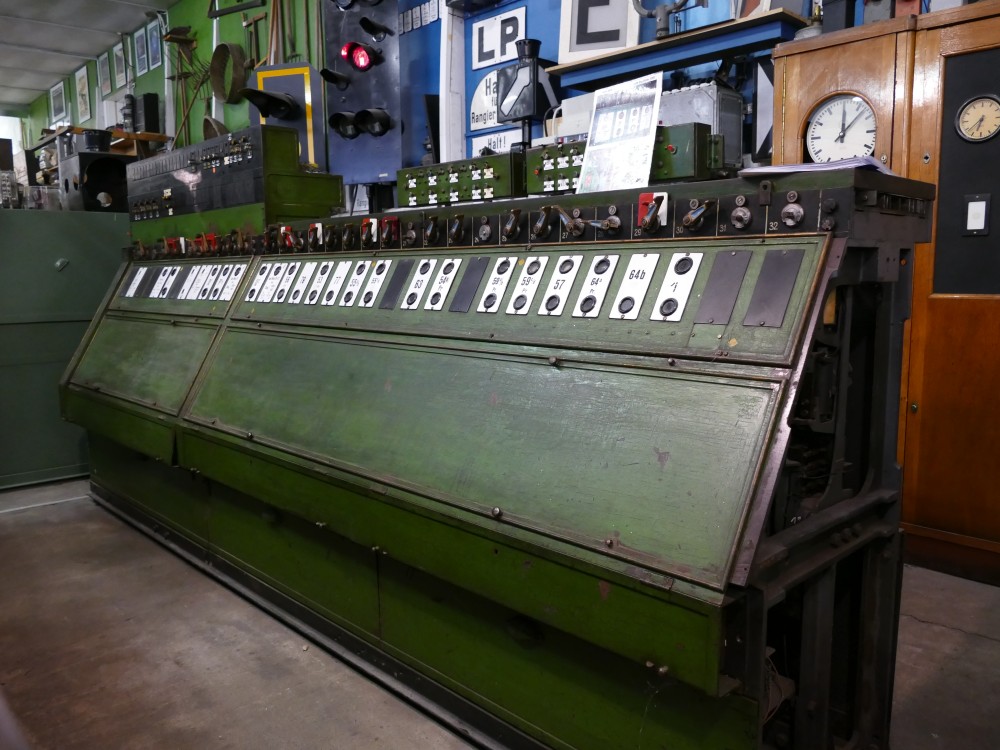
Here is something much larger: This is a GS 0 panel from the sigal box Kwm at Königs Wusterhausen, which was operated from 1951 until 2006. GS 0 was the first type of relay interlockings in the former GDR:

GS0 panel from signal box Kwm at Königs Wusterhausen, railway museum Letschin, 2020

GS0 panel from signal box Kwm at Königs Wusterhausen, railway museum Letschin, 2020

The following details shows the old-fashioned use of screws to fasten the panel elements:

Detail of the GS0 panel from Königs Wusterhausen, railway museum Letschin, 2020

Also this panel, from Lübbenau Süd, is from an GS 0 interlocking. This seems to be a pure command panel, for commands to signal box W2 and signal operation at signal box B1 itself. Points at B1 were apparently controlled from some other interlocking, maybe even a mechanical frame:

GS0 panel from Lübbenau Süd, railway museum Letschin, 2020

Here is a detail of the panel's right side:

Detail of GS0 panel from Lübbenau Süd, railway museum Letschin, 2020

DrS—short for "Drucktastenstellwerk Siemens", i.e., "Pushbutton interlocking Siemens"—was one of the most widely deployed types of relay interlockings in Germany. The original location of the following DrS panel is unknown. It was probably controlling the points and signals at the end of a marshalling yard and not the points below the hump: A hump panel would have been oriented the other way round; also, the points are not located for efficient humping, i.e., in a regular branching tree:

DrS panel, railway museum Letschin, 2020

As a final exhibit, the following pictures show an enormous DrS panel of an industrial railway, namely BASF's Ludwigshafen interlocking:

DrS panel BASF Ludwigshafen, railway museum Letschin, 2020

DrS panel BASF Ludwigshafen, railway museum Letschin, 2020

At the end of this posting, here is a collective picture of Letschin exhibits ...
View of quite a few exhibits, railway museum Letschin, 2020

... an unknown group of line block instruments now used for the model railway, ...

Line block instruments, railway museum Letschin, 2020

... and a few signals outside the museum building; the largest one is a colour light signal from before 1945:

Signals, railway museum Letschin, 2020

Finally, here are a few pictures of Letschin's still operational interlocking: The line is operated by signal-supported DTC, with key locks for all points. For Letschin's two sets of points, a small key interlocking is mounted outside right near the track:

Key interlocking, railway museum Letschin, 2020

Key interlocking, railway museum Letschin, 2020

Key interlocking, railway museum Letschin, 2020

And that's it—I hope you found this exhibition as interesting as I did; and maybe you and I find time to pay a personal visit to Letschin's interlocking museum. Many thanks, again, to Robert for this series of images and help with the texts!

Saturday, January 22, 2022

The railway museum at Letschin im Oderbruch, 2020 - a tour with pictures, part 3

Deutsche Version dieses Postings

After the generation of mechanical frames, electro-mechanical ones were introduced in Central Europe. Siemens & Halske (abbreviated S&H) installed the first one in 1894 at Prerov in Moravia (then, a part of the Habsburg monarchy), with another one in Germany at Berlin Westend in 1896. These were one-of-a-kind frames, but soon thereafter, Siemens developed a standard type called "1901" after the year of its introduction. The locking bed was taken from the mechanical Siemens type 3414 (which was very rarely installed in Germany, but was a standard type throughout many other European countries). This example of a 1901 frame stood at Berlin-Halensee:

S&H 1901 originally at Berlin-Halensee, railway museum Letschin, 2020

S&H 1901 originally at Berlin-Halensee, railway museum Letschin, 2020

The next type was designed from the ground up in 1907—here is one that survived at Eberswalde::

S&H 1907 originally at Eberswalde, railway museum Letschin, 2020

And here a small frame of standard type 1912 can also be seen—this type is obviously directly derived from type 1901. 1912s and minor variations that were developed over the following decades numbered in the thousands and were installed in many European countries:

S&H 1907 originally at Eberswalde, to the left there is an unknown S&H 1912, railway museum Letschin, 2020

S&H 1907 originally at Eberswalde, on the left an unknown S&H 1912, railway museum Letschin, 2020

The following picture shows a large 1912 frame from an unknown location:

S&H 1912, railway museum Letschin, 2020

Special Siemens & Halske frames were built for the Berlin underground. Similar frames were also used on Vienna's "Stadtbahn" (the precursor to the underground) in the 1920s, some of which I documented a few years ago—that posting has some additional explanations of this type (currently only in German). It is unclear whether this type was called "1915" officially:

S&H 1915 originally at Kottbusser Tor (Berlin underground), railway museum Letschin, 2020

S&H 1915 originally at Kottbusser Tor (Berlin underground), railway museum Letschin, 2020

During the times of the GDR, the Siemens type 1912 was modernized in many respects, which lead to type E12/78 (E for electro-mechanical, 12 for 1912, 78 for the year of the modernization):

E12/78 originally at Seelow (Mark), railway museum Letschin, 2020

In addition to the standardized E12/78, there were many additional improvements of 1912 type frames in Germany as well as in other countries. Here are a few examples from the Letschin museum:

Unknown modified interlocking frame derived from S&H 1912, railway museum Letschin, 2020

Unknown modified interlocking frame derived from S&H 1912, railway museum Letschin, 2020

Unknown modified interlocking frame derived from S&H 1912, railway museum Letschin, 2020

Larger stations with many points often had multi-row frames, typically with two or four rows (there was also a seven-row fame at Maastricht in the Netherlands). Here is a frame with two lever rows from Berlin-Grünau:

VES two-row lever frame originally at Berlin-Grünau, railway museum Letschin, 2020

VES two-row lever frame originally at Berlin-Grünau, railway museum Letschin, 2020

VES two-row lever frame originally at Berlin-Grünau, railway museum Letschin, 2020

Saxon railways for a time used a special "Saxonian station block", which allowed to set routes in large stations more efficiently than standard station blocking circuits. However, because of its technical complexity, it was not used anywhere else. Here is a command frame for such a Saxon station block from Dresden-Neustadt, built by Siemens. The frame looks similar to the upper part of a Siemens two-row lever frame which was used in Austria at signalbox 4 at shunting yard West in Linz:

Command frame of a Saxonian station block from Dresden-Neustadt, railway museum Letschin, 2020

Command frame of a Saxonian station block from Dresden-Neustadt, railway museum Letschin, 2020

Of course, there were other manufacturers of electro-mechanical frames besides Siemens. Here is a frame by AEG (an abbreviation for "Allgemeine Elektrizitäts-Gesellschaft", i.e. "general electric company"):

AEG electro-mechanical frame originally at Henningsdorf bei Berlin, railway museum Letschin, 2020

AEG electro-mechanical frame originally at Henningsdorf bei Berlin (in the background S&H 1901 originally at Berlin-Halensee), railway museum Letschin, 2020

Finally, here is a frame by Gaselan:

Unknown Gaselan two-row electro-mechanical frame, railway museum Letschin, 2020

Unknown Gaselan two-row electro-mechanical frame, railway museum Letschin, 2020

The same frame, but here a station block of type 51 stole into the picture:

Unknown Gaselan two-row electro-mechanical frame, railway museum Letschin, 2020

In the last picture, one can see another two row frame by Gaselan, which did its work at shunting signalbox Fgw at Frankfurt/Oder:

Gaselan-Zweireihenstellwerk originally at Frankfurt/Oder, railway museum Letschin, 2020

Gaselan-Zweireihenstellwerk originally at Frankfurt/Oder, railway museum Letschin, 2020

That's it, with electro-mechanical frames. The next and final posting will be about relay interlockings at Letschin.