Showing posts with label Austria. Show all posts

Friday, May 6, 2022

Austrian block instruments south of Brenner - sensational images from a time long past

When South Tyrol and Trentino fell to Italy after World War I, the Brenner railway down to Ala was equipped with interlockings built by the Südbahnwerke, the interlocking factory the line's owner, both for station and line blocking. The Italian railways FS continued to operate these installations, and they are mentioned in passing in individual documents. The interlockings in the stations are listed under "Apparati Centrali a doppio filo" (i.e. interlockings with double wires), but there were also many Jüdel frames with double wires in Italy, so that one cannot conclude directly from this designation that some frame was a Südbahn frame.

Here are the only two references to these frames I know:

a) On the web site http://www.ilmondodeitreni.it, one finds the entry
3) Apparati Centrali a doppio filo (con bloccamento elettrico degli itinerari, ex Austriaci)
unfortunately without any links.

b) The book "Impianti di Sicurezza" by Vittorio Finzi, published in 2001, contains the following on page 14:
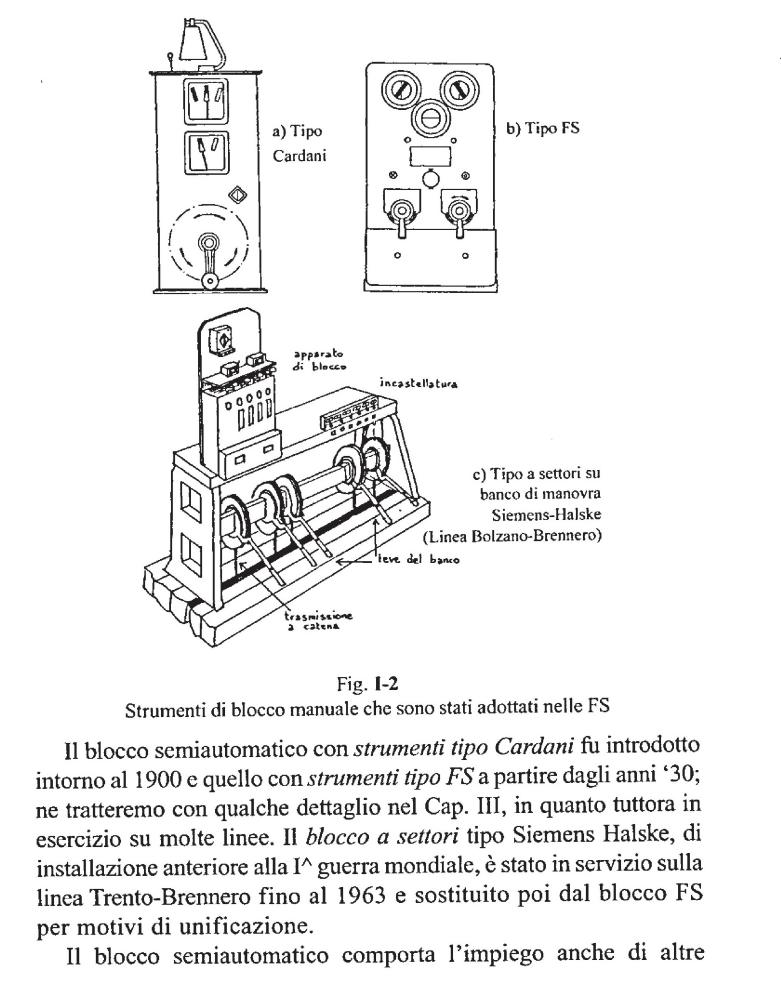

Translated:
The semi-automatic block with Cardani type instruments was introduced around 1900, the FS block is from the 1930s; we will deal with both in detail in Chapter III, as they are still in operation on many lines. The Siemens Halske type line block, installed before World War I, was in operation on the Trento-Brennero line until 1963, when it was replaced by the FS block for reasons of standardisation.
I have not found more than these two mentions so far.

But now Mattia—who found my blog on the internet and who emails me back and forth from time to time; he also has a small railway museum somewhere on the Tendabahn, if I understand it correctly, where I want to visit him—sent me four pictures that are very interesting. I don't know when they were taken; I'll have to talk to him about them from time to time—but here they are:

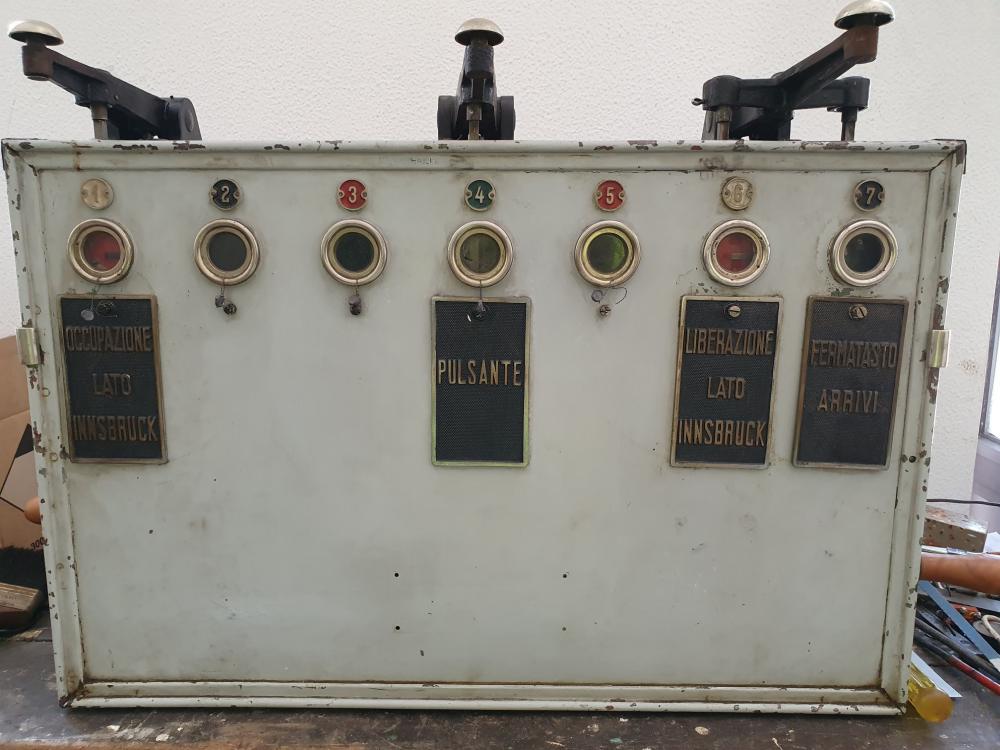
First image—Mattia writes: "I have had some photo sent to me by a friend who is a signalman in Trento; ... the only remaining apparatus was in the cabin of the Brenner station". The block apparatus is already removed here from the signal box. The designation "Pulsante" under the middle button simply means "push button" or "key" in Italian—not really helpful to understand its function:

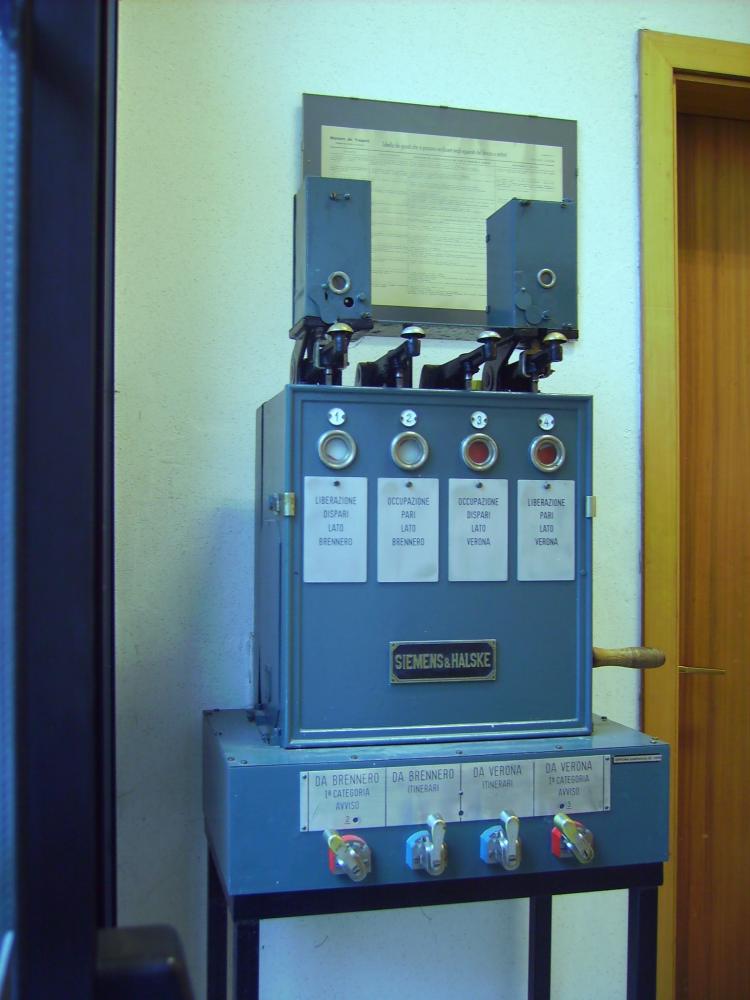
Second and third image—Mattia writes: "I also found a photo from the technical school in Bolzano, it would appear that there is no classic anchor but a toothed wheel".
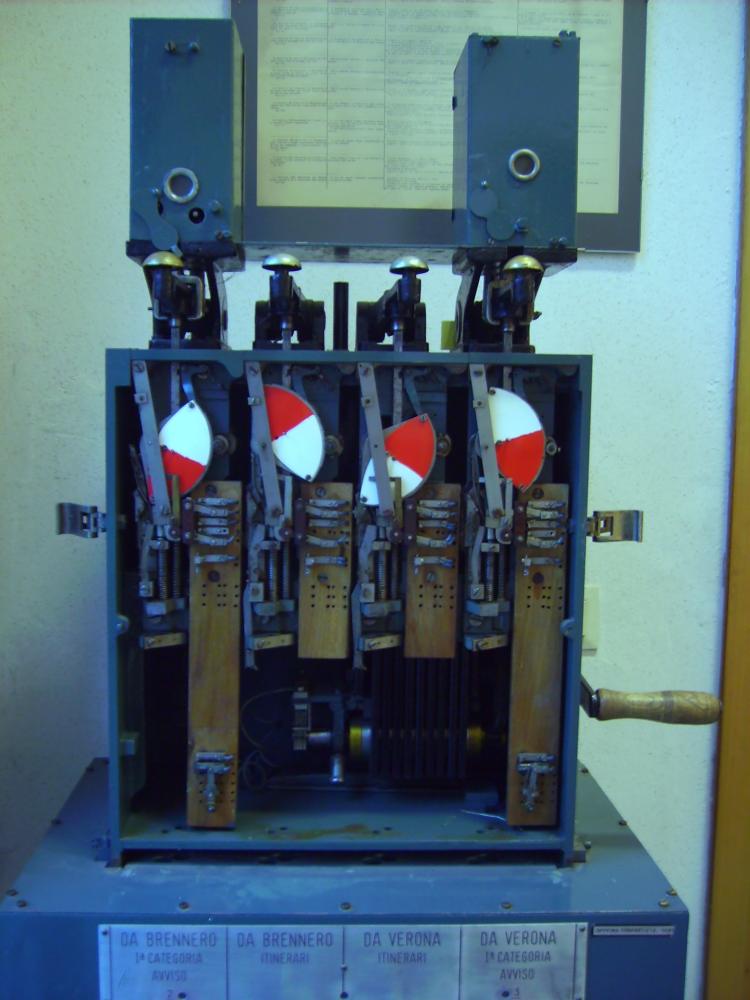


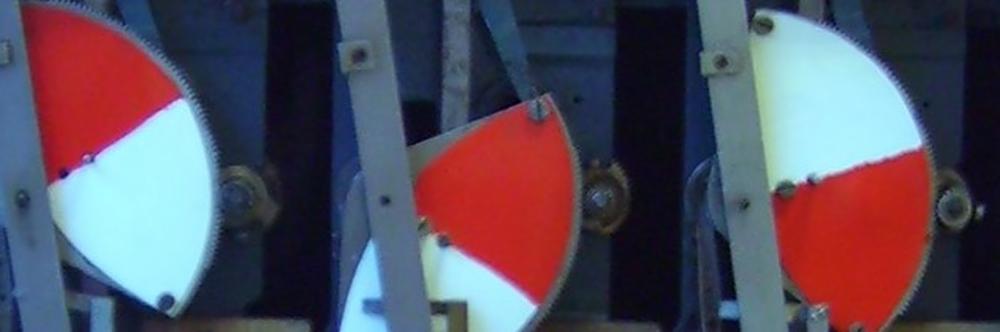
I have enlarged a part of the second picture; the resolution of the pictures is not very high, but you can actually see that the segment discs have a much finer toothing and are motor-driven by a pinion:

Mattia writes: "With regard to the modification in the block, I can confirm that it is as you said, engineer Pacetti was talking about it in the “la Tecnica Professionale” magazine, the blocks have been modified for direct current working, so that there could be no interference due to the alternating current cable for the locomotives."—there seem to exist more documents somewhere. The reason for the modification given probably refers to the fact that the Brenner line was electrified with three-phase current 3.6 kV/16 2/3 Hz from 1928 onwards.

A last picture by Mattia shows the distribution of block systems in Italy in 1939, mentioning the "Blocco a Settori" for the Venezia division, i.e. the Siemens&Halske track block under the designation also from the above mentioned book. Mattia writes: "The graph in the photo shows the kilometers of railway line in which the S&H railway block were used (gray)."
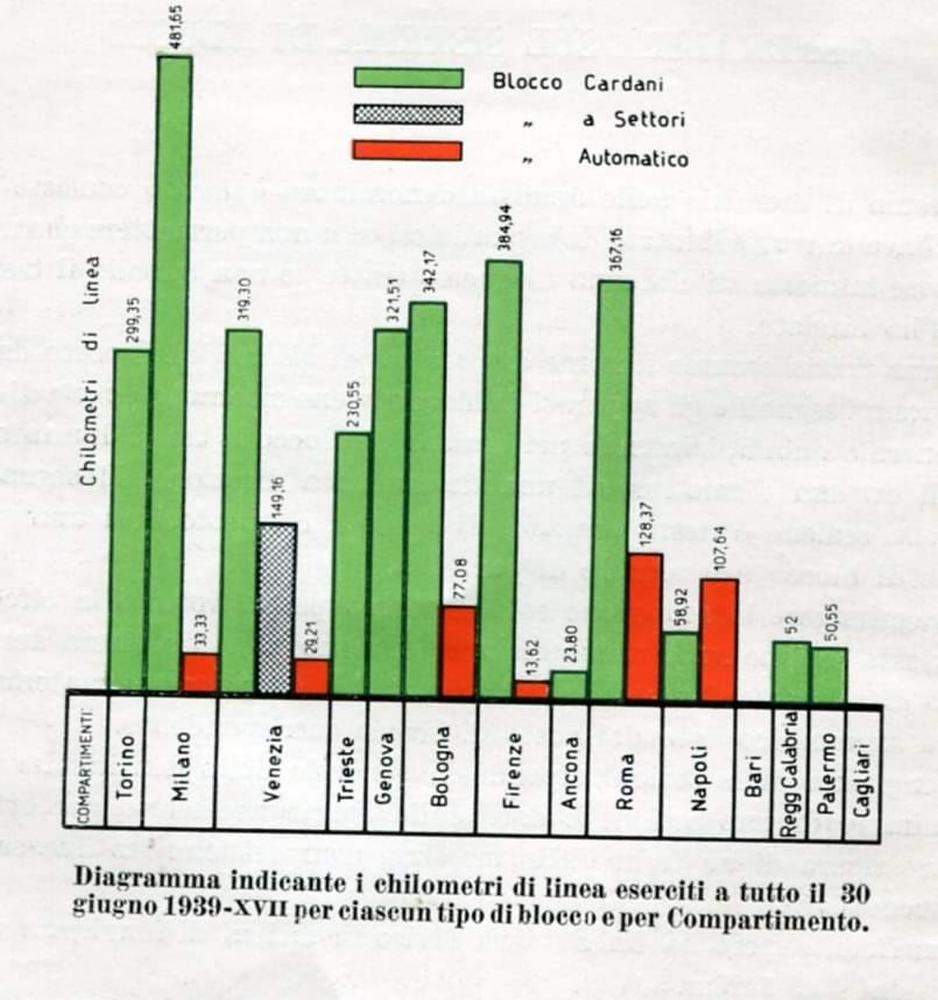

Today's divisions can be seen at this website of Rete Ferroviaria Italiana (RFI). Today Verona is a separate division, in 1939 this area was apparently still assigned to Venezia.

That's it (so far) from this probably largely unknown branch of former Austrian and then Italian safety installations. Many thanks to Mattia for this glimpse into the past and an unexpected technical detail!

Friday, April 29, 2022

A few pictures from Gmünd NÖ, August 1991

Deutsche Version dieses Postings

In the summer of 1991, we went on a trip through the "new states" of Germany, not only, but also because of the railway. Not too many and somewhat random railway shots were taken there, which I want to show here in a few postings without many explanations. Unfortunately, the exact shooting dates and also locations have been lost; but kind spirits in Germany's Drehscheibe-Online-Forum have already identified some, and I will ask for more.

The start of our trip was at Gmünd in Lower Austria, on a rather rainy Sunday, as far as I can remember. The following pictures were taken there:

298.207 and an unidentified 399, Gmünd, NÖ, August 1991

The designation of this old Mh can really only be called exaggerated, compared to the 399.02 on later pictures:

2143.035, 298.207 and 0399 004-1, Gmünd, NÖ, August 1991

298.207, Gmünd, NÖ, August 1991

399.02 arrives from Groß Gerungs:

399.02, Gmünd, NÖ, August 1991

399.02, Gmünd, NÖ, August 1991

399.02, Gmünd, NÖ, August 1991

399.02, Gmünd, NÖ, August 1991

CSD 754 007, Gmünd, NÖ, August 1991

Home signal at the border, Ceské Velenice, August 1991

Tuesday, January 4, 2022

Trouble with the EM55 at Hadersdorf/Kamp, Lower Austria, in 2019

Here is a short posting with two year old pictures of the EM55-type interlocking machine at Hadersdorf/Kamp in Lower Austria. I had visited my mother, and before leaving from Hadersdorf, I looked into the traffic bureau. There, two signal technicians had worked for more than six hours on locating a problem with a signal, with—at the time of my visit—no tangible result. One of the two graciously took photos with his smartphone, which you can see below:

Opened EM 55, traffic bureau Hadersdorf, 2019

Opened EM 55, traffic bureau Hadersdorf, 2019

Opened EM 55, traffic bureau Hadersdorf, 2019

Opened EM 55, traffic bureau Hadersdorf, 2019

Opened EM 55, traffic bureau Hadersdorf, 2019

Here is part of the circuit diagram, studied by the technician to understand what's going on:

Part of the EM55's circuit diagram, traffic bureau Hadersdorf, 2019

The interlocking is still operational as of today, but its end of life will come in 2022 or 2023 at the latest.

Monday, September 16, 2019

Hollabrunn's signal boxes, 1990

German version of this posting

This is, I'm sad to say, my last complete documentation of the interlocking frames of an Austrian station from the last century. However, I'll continue to post in this blog with about 200 more pictures from various countries around the world, which will show interesting semaphores and interlocking frames from the 1990s. After this—well, it seems to be over, then. So it goes.

Hollabrunn, in 1990, had a refurbished set of 5007 frames with the typical Austrian layout: A traffic bureau in the station building and a signal box at each end of the station tracks. Here is the command frame in the traffic bureau, with a poster calling for secure working conduct that is typical of this time:

Command frame, traffic bureau, Hollabrunn, 14.8.1990

The command frame had been built anew in the 1980s with small route levers. Besides the typical six block instruments for station blocking of a single line, it had an additional instrument that would unlock points 32 and 32 in the middle of the station tracks. On the left, there were four small levers for unlocking derails and another set of points, W34. And even though the calendar shows still the 13th of August, I know that I took this photo on the 14th: Because that is the date shown at Retz's signal box 1, which I have definitely visited before Hollabrunn:

Command frame, traffic bureau, Hollabrunn, 14.8.1990

On the traffic director's desk, there was this ÖBB-built signal panel, which additionally had the controls for three barriers on the line to Vienna:

Signal panel, traffic bureau, Hollabrunn, 14.8.1990

The next photo is already from signal box 1. Splitting the single track of the line into four station tracks (3, 1, 4 and 6—track 2 had been removed when the centre platform had been erected), three sets of points are sufficient; and only two of them, in the straight through track, need facing point locks. So, we end up with five levers altogether, as the FPL levers are reversible "three-position" levers that can be used to move the locks to either position: Such a lever is either moved up with the handle pulled to lock the points in the normal position; or it is first moved up without pulling the handle and then, with handle pulled, moved down—this will turn the wheel in the other direction and lock the points in the reverse position):

Interlocking frame, signal box 1, Hollabrunn, 14.8.1990

Below the track indicator, there was a key lock for an "A/C dependency", i.e., the key would unlock a derail, after which one could extract another key there to unlock the points leading to the derail. At the upper left, there is a beeper indicating that a barrier had to be closed manually if a route was set for a train:

Track indicator and related instruments, signal box 1, Hollabrunn, 14.8.1990

The signal panel was quite minimalistic. Besides the few buttons, lamps and symbols for the signals, there was a set of monitoring lamps and override buttons for a train-controlled barrier inside the station limits:

Signal panel, signal box 1, Hollabrunn, 14.8.1990

Signal panel, signal box 1, Hollabrunn, 14.8.1990

Here is the low building of the signal box:

Signal box 1, Hollabrunn, 14.8.1990

While I walked to the other signal box, the train from Retz rumbled through on its trip to Vienna:

2050.011, Hollabrunn, 14.8.1990

The old station had been optically cut in two by a large platform shelter. But the building itself had been renovated quite nicely:

Station building, Hollabrunn, 14.8.1990

Station building, Hollabrunn, 14.8.1990

Here, I am approaching signal box 2, of which I have taken a rare back-side photo:

Signal box 2, Hollabrunn, 14.8.1990

This is the compact type 5007 lever frame. In contrast to signal box 1, it is completely occupied by levers, without any space for old signal levers—thus, it must have been built newly when the station was redesigned in the 1980s:

Interlocking frame, signal box 2, Hollabrunn, 14.8.1990

The points levers have each two positions, whereas the FPL levers were three-position levers of the same type as in signal box 1. The rightmost lever had, for some reason, a larger wheel, which would give it a wire travel of 610 mm instead of the standard 500 mm. Below the track indicator, there are the small route levers. Towards their left is a row of small levers for shunting signals:

Interlocking frame and track indicator, signal box 2, Hollabrunn, 14.8.1990

The two sets of points 31 and 32 in the middle of the station tracks had large "Madner" levers, which made it possible to release them for ground reversal during shunting. On the far left is the block instrument for releasing these levers from the traffic bureau (the label Ze means "Zustimmungsempfang" or "admission receive"; it should also have an additional text telling what was admitted by it—but that was forgotten, out of laziness, I assume):

Block instruments and lever frame, signal box 2, Hollabrunn, 14.8.1990

The small signal panel has a few buttons for the starting and home signals, two sets of barrier monitoring controls, and a larger number of shunting signal symbols—these signals were cleared by small levers as mentioned above:

Signal panel, signal box 2, Hollabrunn, 14.8.1990

Out of the signal box's window I took this photo of points no. 52. It shows a typical Austrian points installation: The heavy weight, which would forcefully lock the blade locks, was on the opposite side of the linkage moving the points. On the same side as the weight and to the left of it is the cover of the facing point lock; one can see its connection rods leading to the very points of the blades. Both covers, of the moving linkage and the FPL, are nicely painted with yellow warning stripes to make them more visible:

Points no. 52, Hollabrunn, 14.8.1990

Here is the signal box, which was built into the slope near the tracks:

Signal box 2, Hollabrunn, 14.8.1990

Hollabrunn had, at that time, a small pedestrian-only barrier leading over the tracks. Three photos of this small contraption conclude my presentation and documentation of this station:

Pedestrian barriers, Hollabrunn, 14.8.1990

Pedestrian barriers, Hollabrunn, 14.8.1990

Pedestrian barriers, Hollabrunn, 14.8.1990

Signal box 1 at Retz, 1990

German version of this posting

The frames at Retz were, even back then, among the last with a complete set of levers—for points, locks, and, above all, semaphores:

Interlocking frame, signal box 1, Retz, 14.8.1990

The signal box was quite small, therefore my photos are angled somewhat strangely. The signal levers are typical for an Austrian single track line: From the right to the left, one can see
  • the single lever for distant signal a
  • the double lever for home signal A; the lower lever clears the signal with one arm, the upper one with two arms;
  • three so-called reduction levers (the name comes from the fact that even though they are reversed by about 180°, the wheel turns only by about 90°, so that the wire travel is 250 mm) for starting signals H5, H3, and H1
  • and finally another reduction lever for grouped starter H2-6 for tracks 2, 4 and 6:

Interlocking frame and block instruments, signal box 1, Retz, 14.8.1990

The track plan above the frame nicely shows all these semaphores, however, all the starting signals miss their names:

Track plan, signal box 1, Retz, 14.8.1990

This photo of the points lever is on the dark side, ...

Interlocking frame and track indicator, signal box 1, Retz, 14.8.1990

... but one can nicely read the labels on the track indicator:

Track indicator labels, signal box 1, Retz, 14.8.1990

Here are all the signal levers and, above them, the block instruments in their normal position:

Signal levers and block instruments, signal box 1, Retz, 14.8.1990

and once again:

Signal levers and block instruments, signal box 1, Retz, 14.8.1990

The small signal box was painted flawlessly:

Signal box 1, Retz, 14.8.1990

A goods train from (still existing) Czechoslovakia rests on its trip to Vienna:

2050.011, Retz, 14.8.1990

And here is a final photo of the station building, with a sole pylon foretelling the coming electrification:

Station building, Retz, 14.8.1990