Monday, October 23, 2017

A journey to Sweden, 1989: Signalling a drawbridge at Lidköping

Deutsche Version dieses Postings

My first photo from Lidköping shows the Fiat class Y1 rail car:
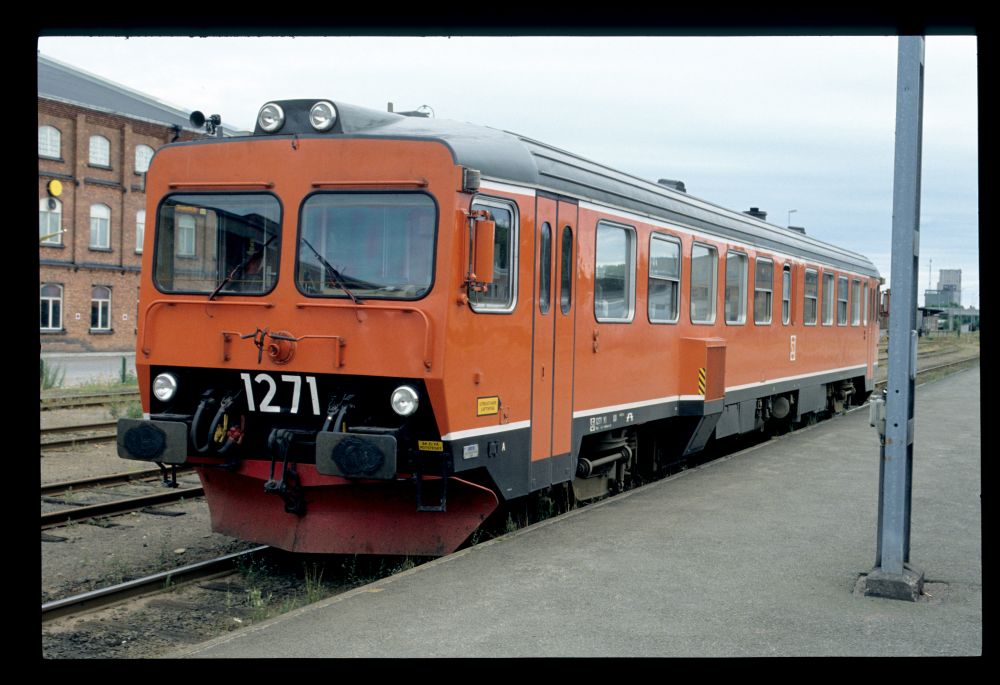
SJ Y1 1271, Lidköping, 17.7.1989

The station building is built in typical Swedish style:
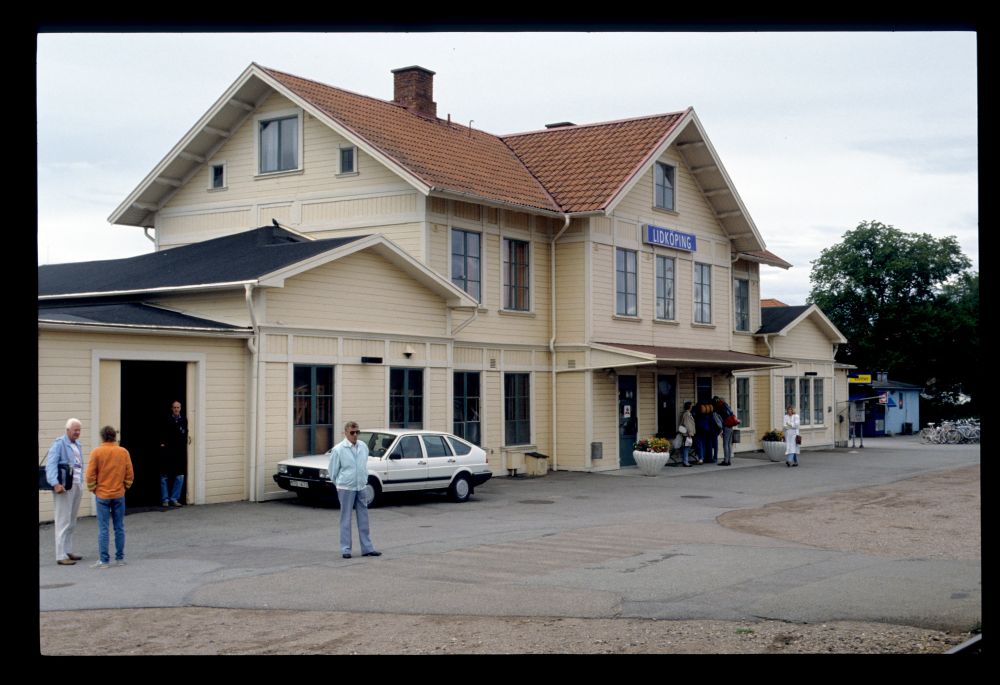
Station building, Lidköping, 17.7.1989

This photo from the western throat shows, directly ahead, our rail car on track 2. Another class Y1 is on track 1 on the right. The station building would be on the right, out of the picture. It is interesting that there are two double switches in the ladder track—in Austria and Germany, the necessary additional frogs would not have been accepted, whereas railways more influenced from Great Britain did not hesitate to use more of them. Moreover, Swedish authorities apparently did not consider it necessary to use separate points indicators—the weights on the points levers were probably deemed to be enough for pointing out the position. On the very right, one can see the locks used to transmit the position to the central interlocking, and additionally lock the points' keys:
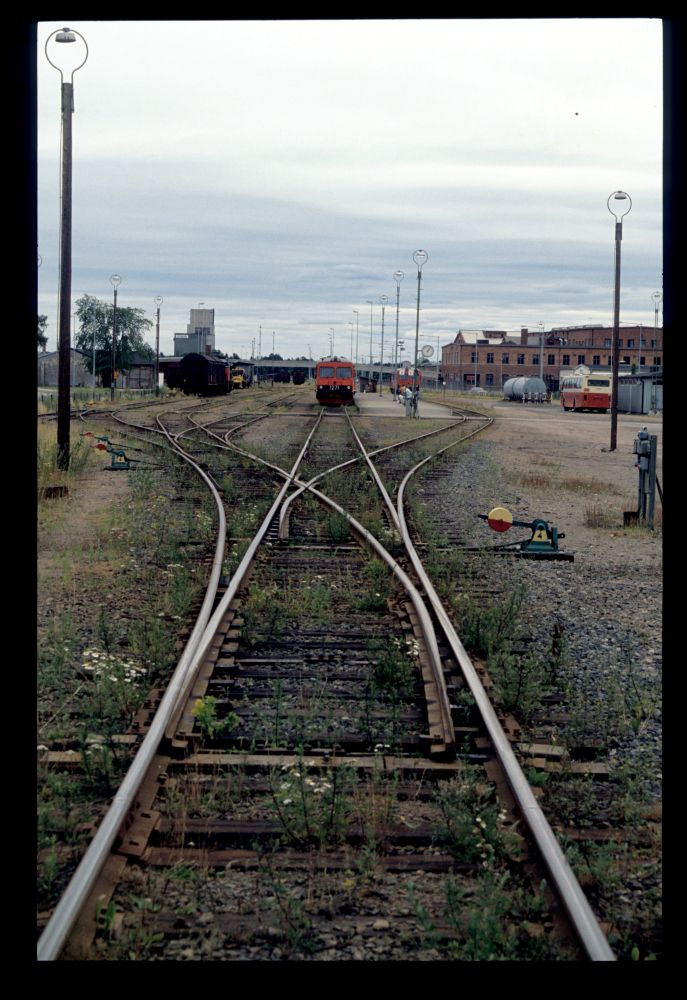
Yard tracks, Lidköping, 17.7.1989

The line from Lidköping towards Herrljunga crosses a drawbridge. One can see the heavy counterweight here above the track, and a few signals:
  • The starting signal Lkp E;
  • a level crossing signal V indicating whether barriers are down;
  • the bridge signal on the right side—the track panel we will see in a moment says that its name is BsI, but this is not shown on the signal itself.
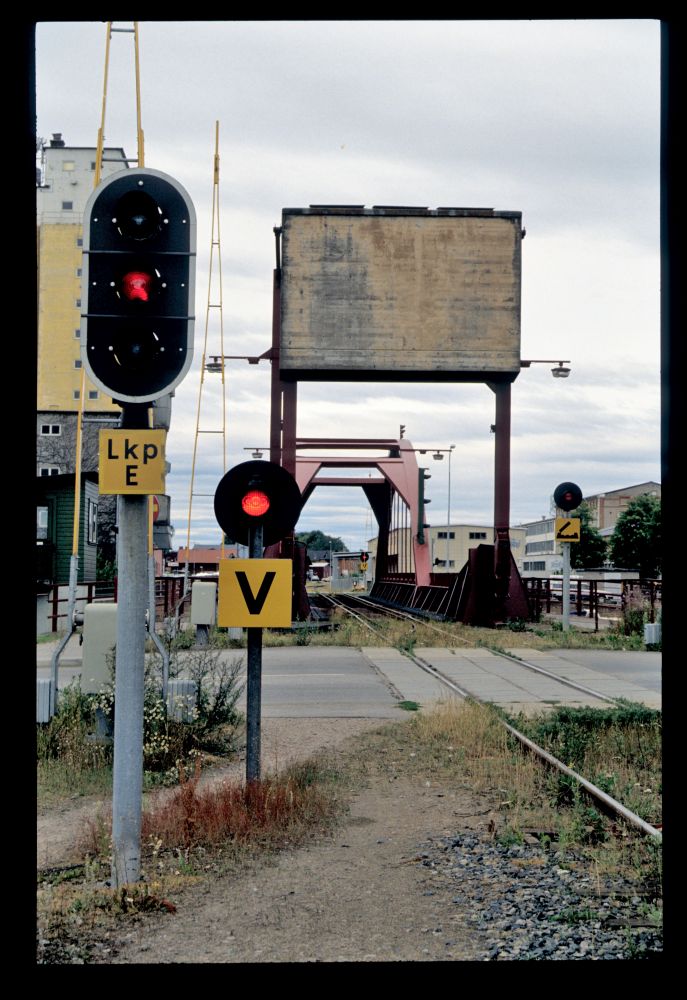
Drawbridge and signals, Lidköping, 17.7.1989

At the station building, there was a typical Swedish small interlocking. In Swedish, they are called centrallås, meaning "central lock". As can be seen above, the points were reversed locally (klot växels, i.e. "ball points"—I assume because of the round weights at the points) and locked by keys:
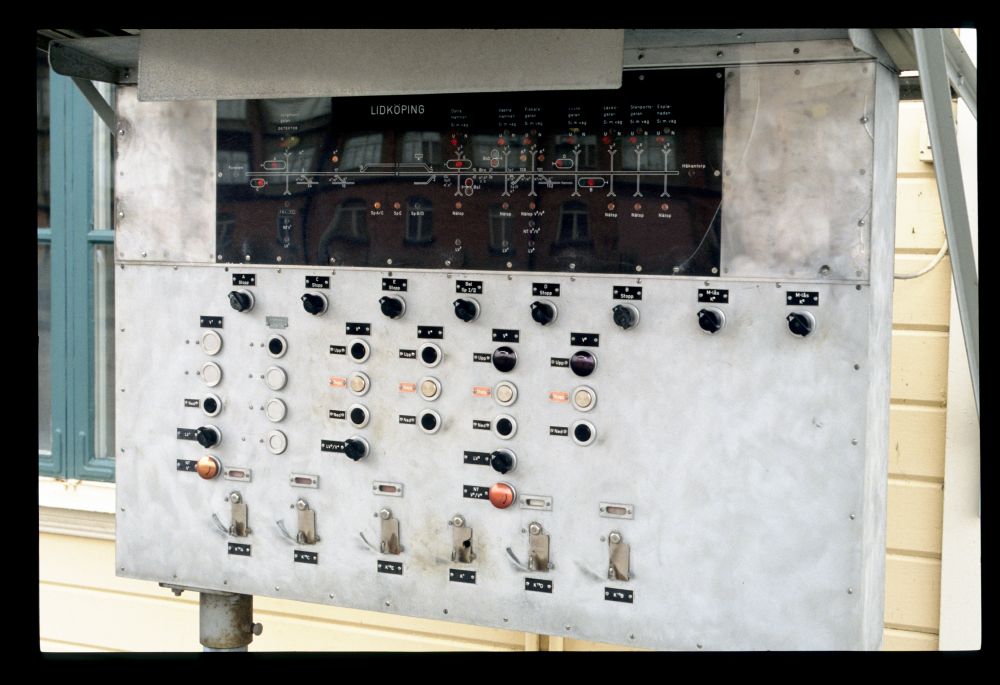
Interlocking, Lidköping, 17.7.1989

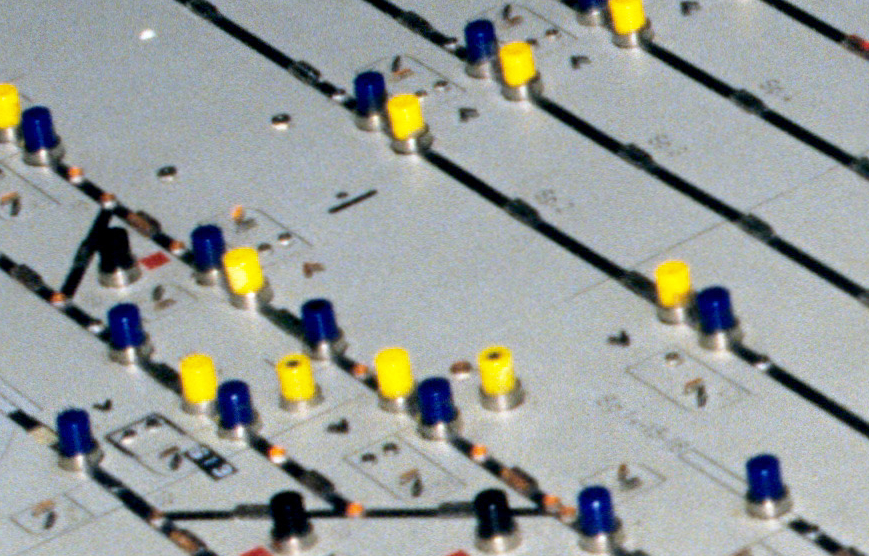
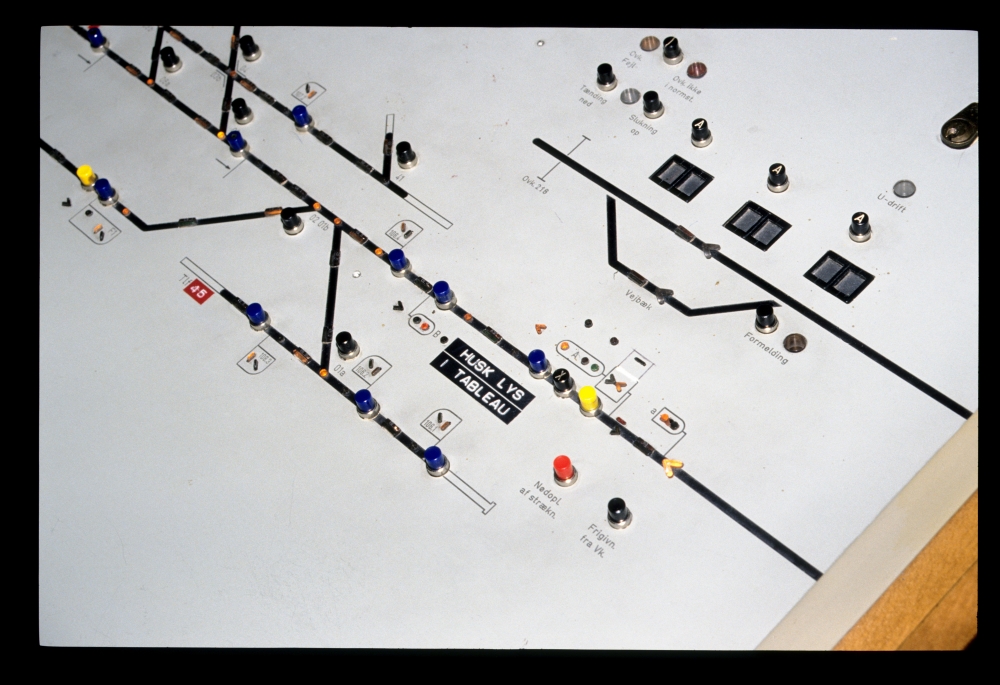
The following picture shows an enlargement of the panel (click opens a readable image). On the left, one can see the home signal from Forshem. Below it is starting signal C. Towards Håkandorp, there are two starting signals: First, there is signal E, and then signal D past all the points (a sort of "outer starter"). Near E, one can see the drawbridge symbol (Bro = bridge), whose protecting signals BsI and BsII are located at the right side. Last, but not least, there is a series of level crossing, with indicator lamps U (Upp = up, barriers are open) and N (Ned = down, closed barriers):
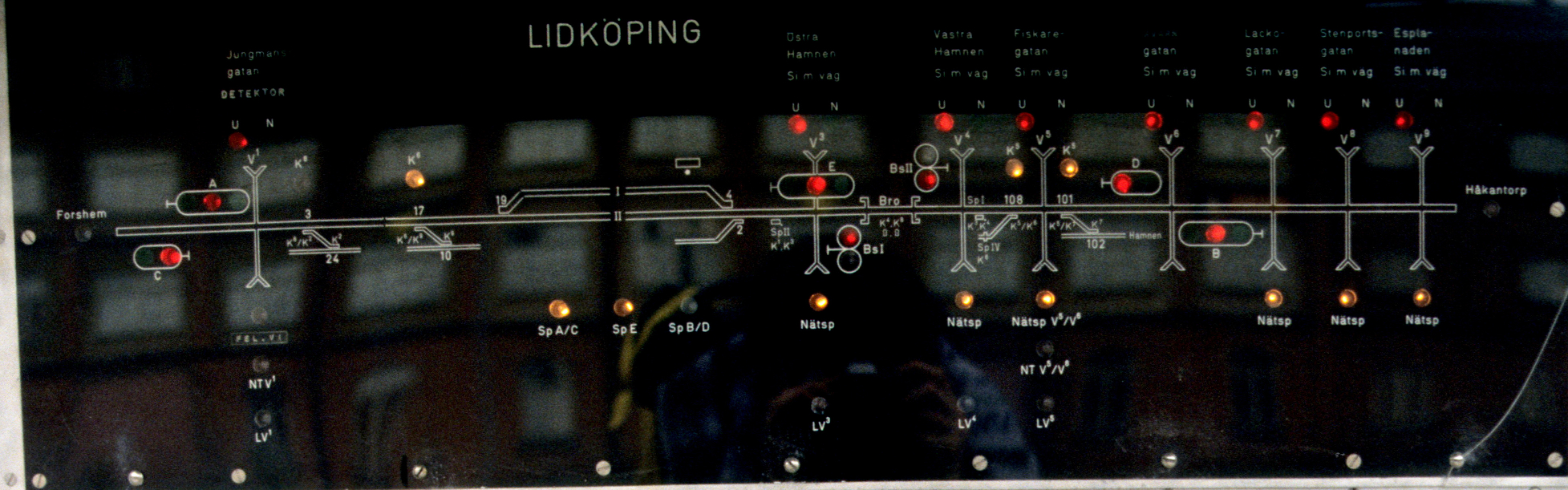
Interlocking panel, Lidköping, 17.7.1989

Here is the right side of panel:
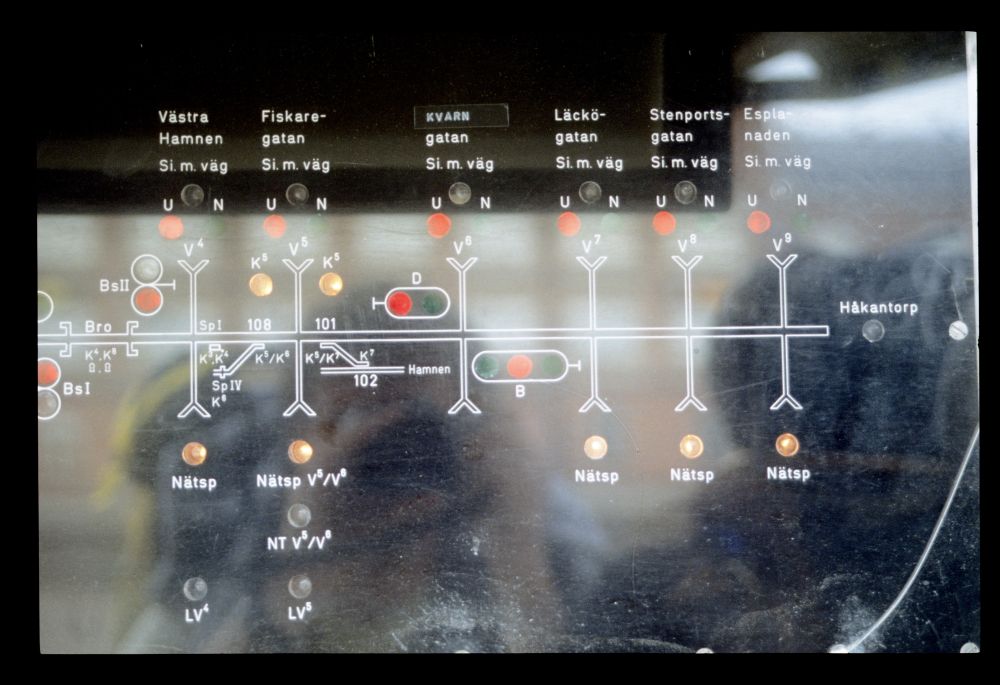
Interlocking, Lidköping, 17.7.1989

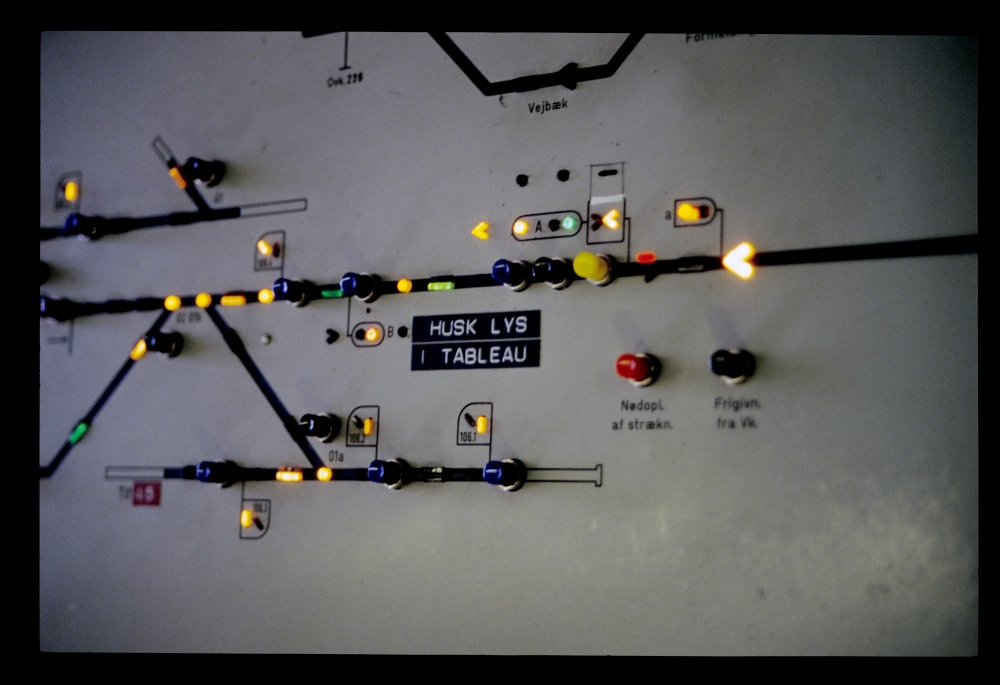
In the following image, one can see that the panel only contains two of the station's five tracks. Apparently, interlocking panels only depict tracks used for train routes. All other tracks are shown only to the nearest flank protection:
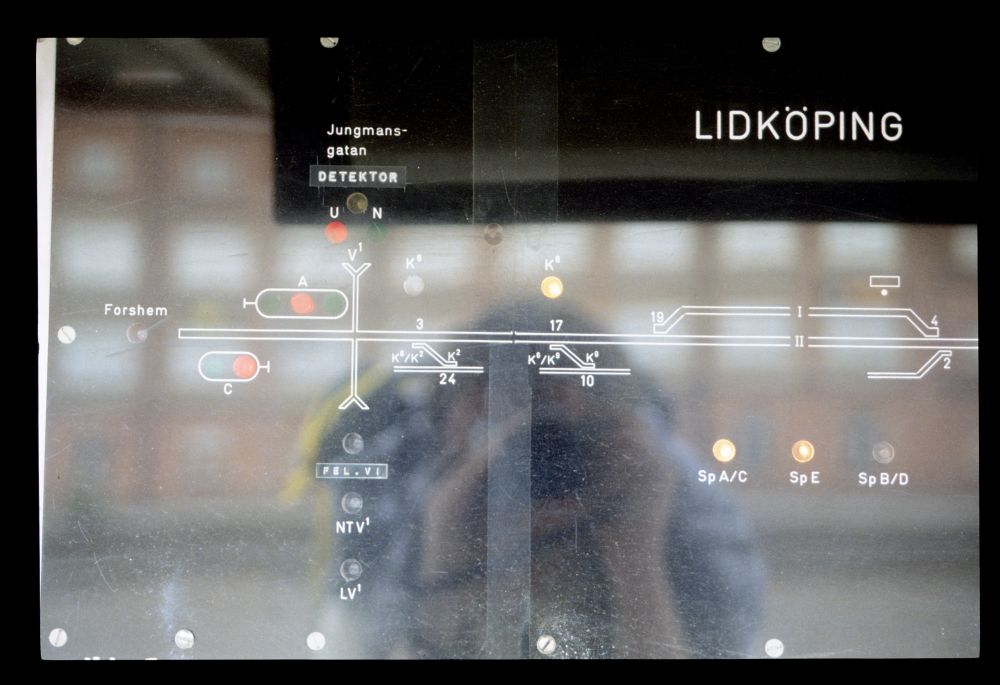
Interlocking, Lidköping, 17.7.1989

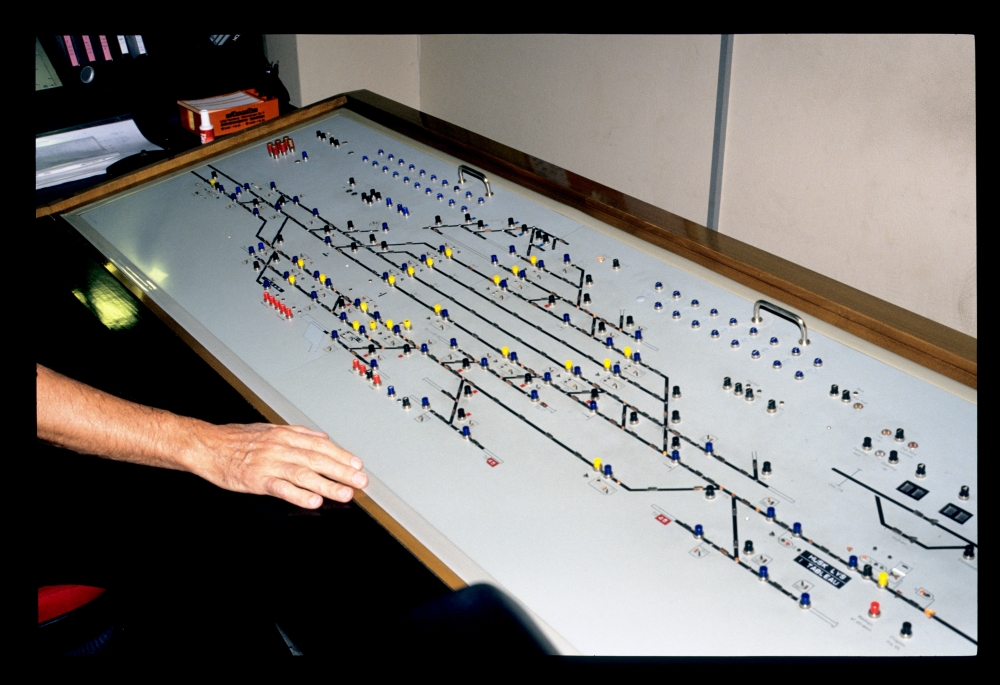
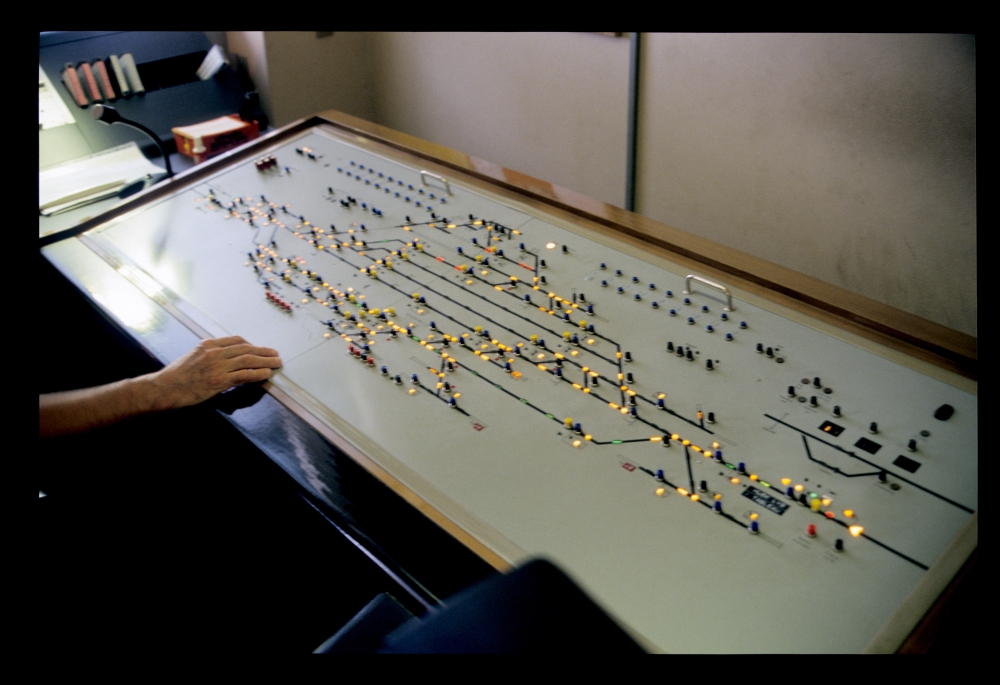
Here is a last picture of the complete interlocking panel (click opens it in full resolution, where one can read all labels):

Interlocking, Lidköping, 17.7.1989

This T43 had arrived with a short goods train, but it did not move while we were in Lidköping:
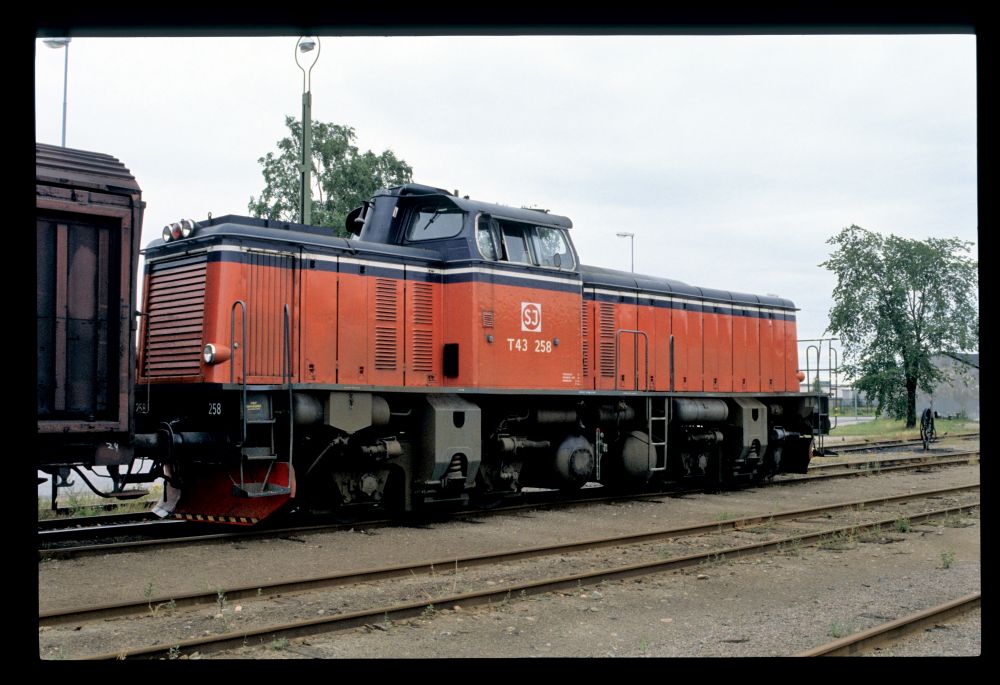
SJ T43 258, Lidköping, 17.7.1989

Outside the station, this SJ bus waited for passengers:
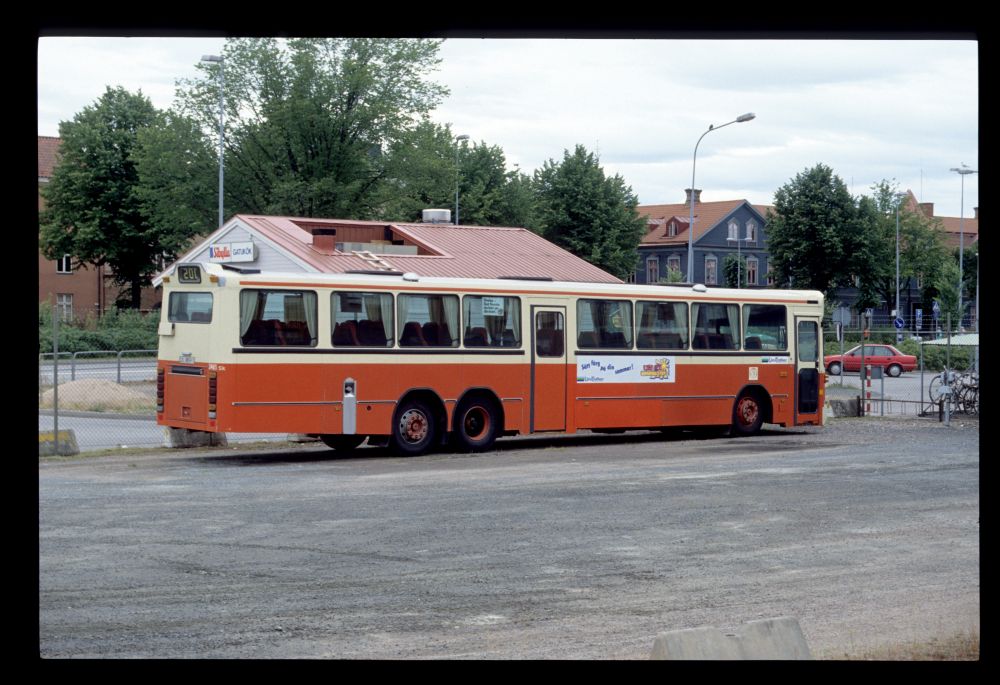
SJ bus, Lidköping, 17.7.1989

Finally, here is a picture that shows home signal Fhm 4/2 of the next station, Forshem:
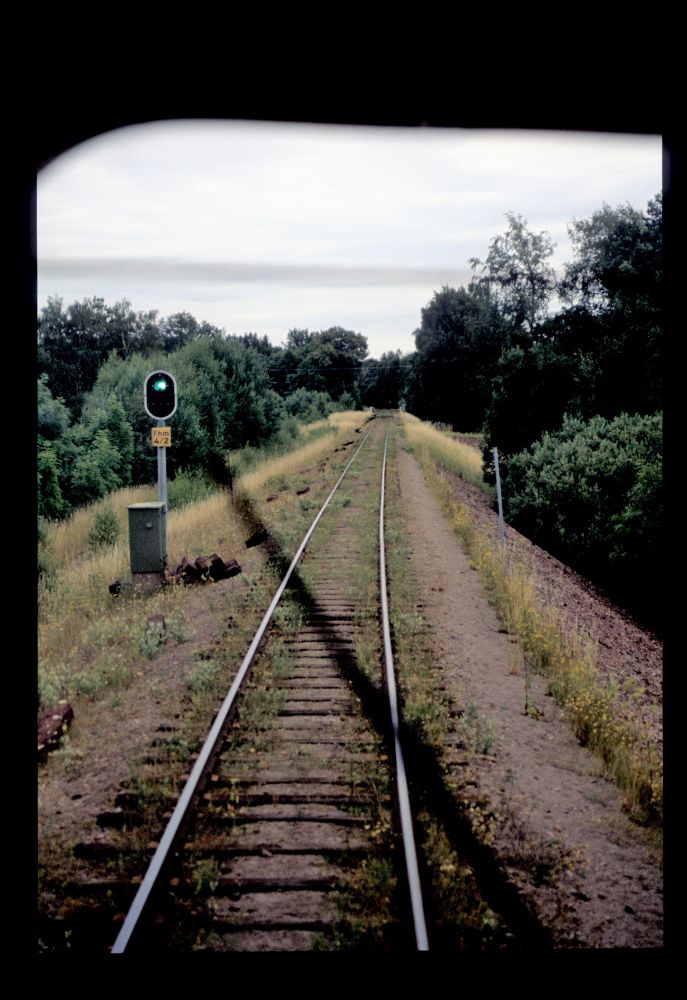
Home signal Fhm 4/2, Forshem, 17.7.1989

Sunday, October 22, 2017

A journey to Sweden, 1989: From Herrljunga towards Lidköping

Deutsche Version dieses Postings

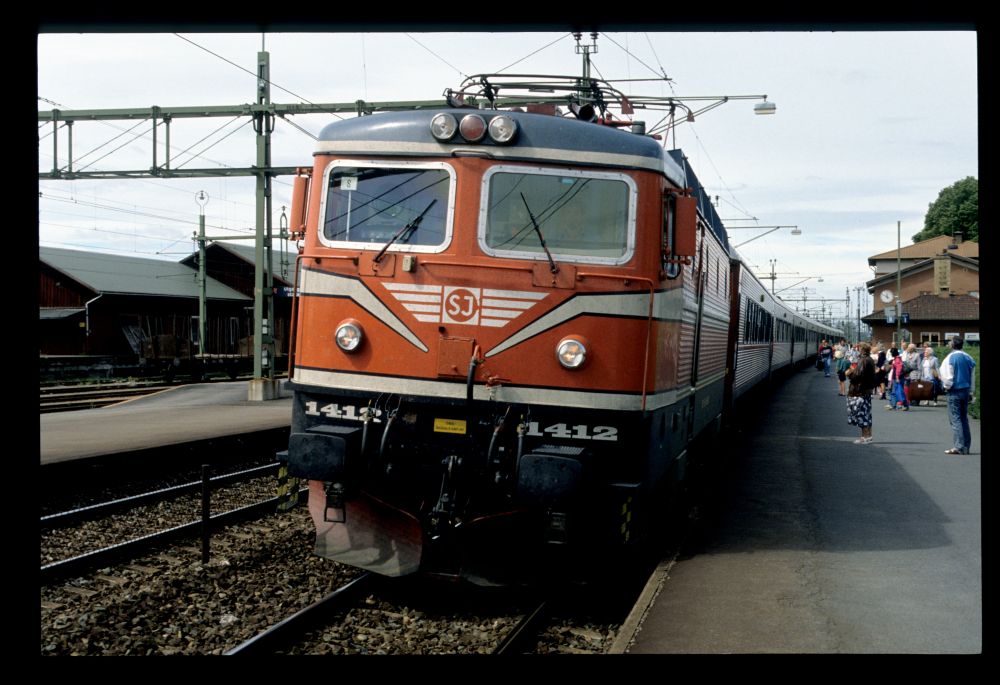
The slight tilt adds additional elegance to this picture of SJ's Rc6 1412 with its train at Herrljunga:

SJ Rc6 1412, Herrljunga, 17.7.1989
With a Fiat rail car, we continued to Lidköping. The line leaves Herrljunga over a few steep crossings:

Herrljunga, 17.7.1989
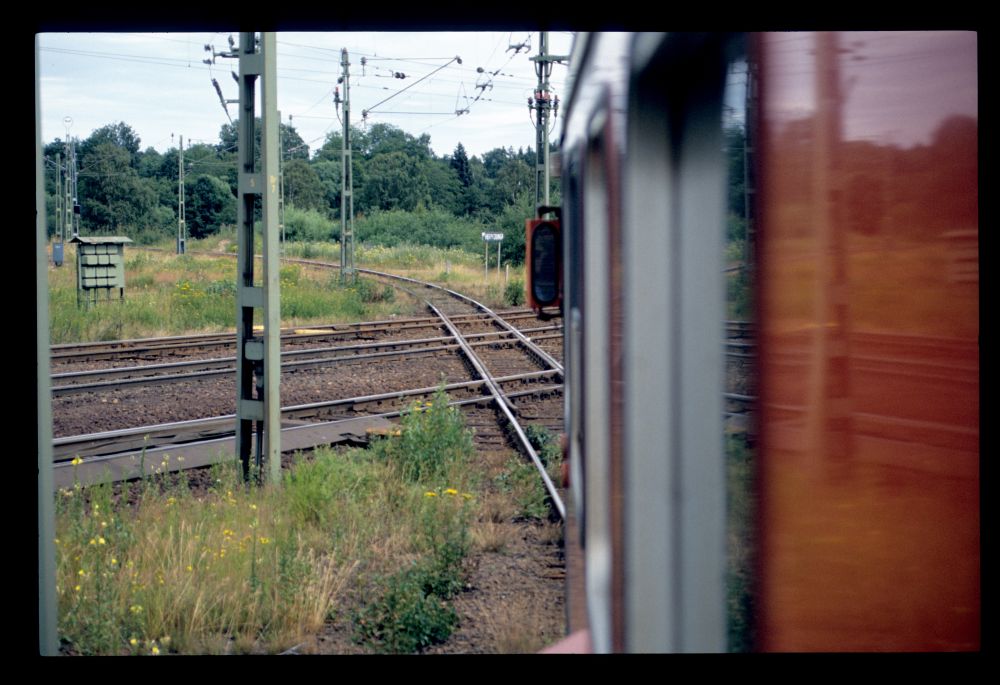
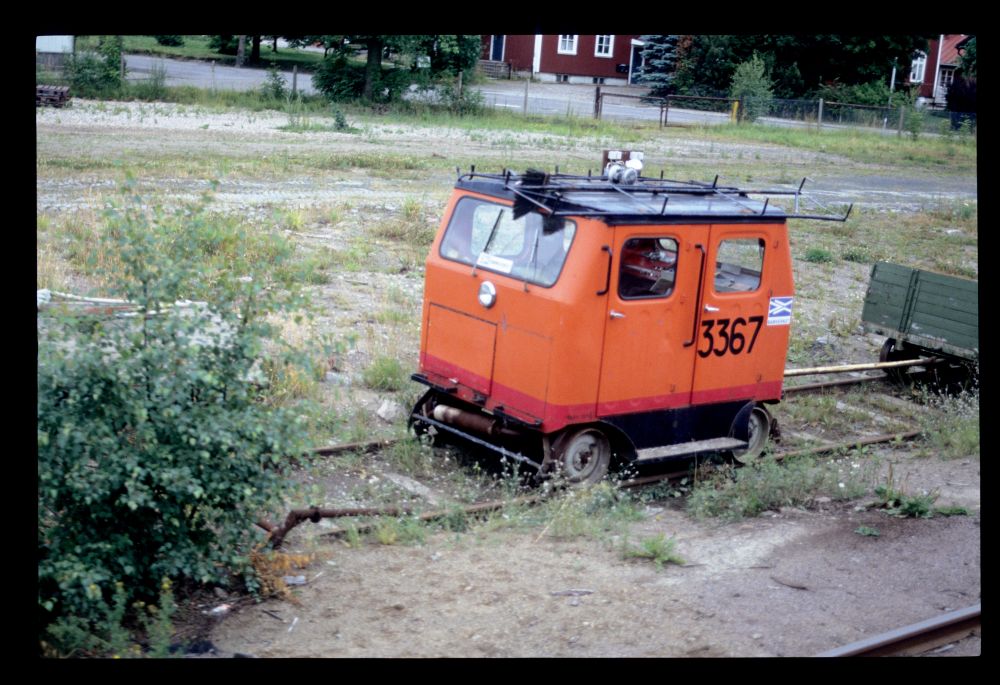
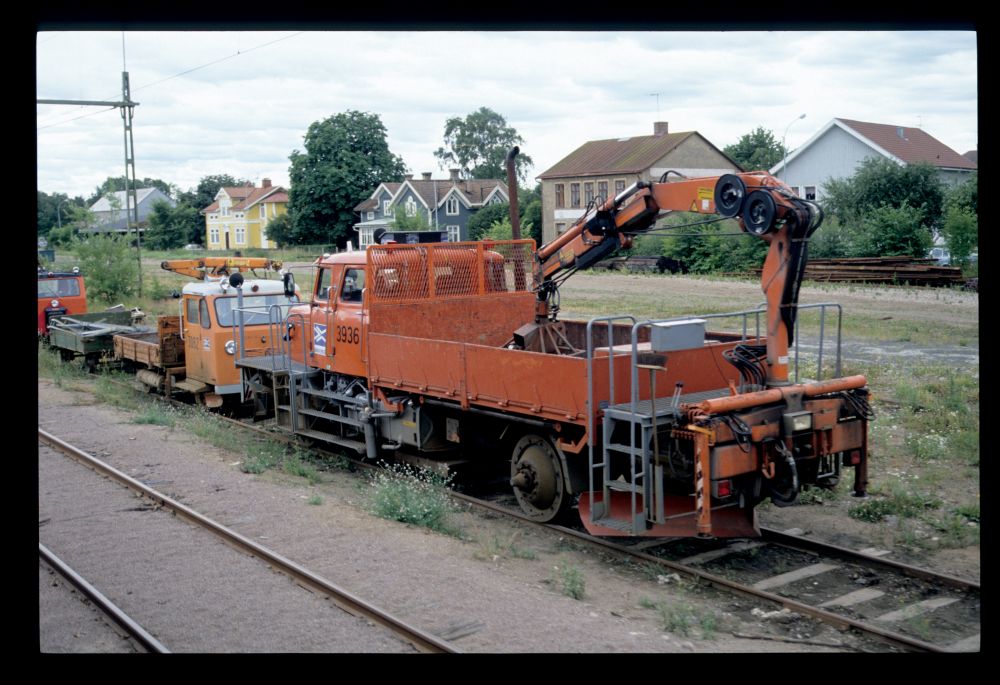
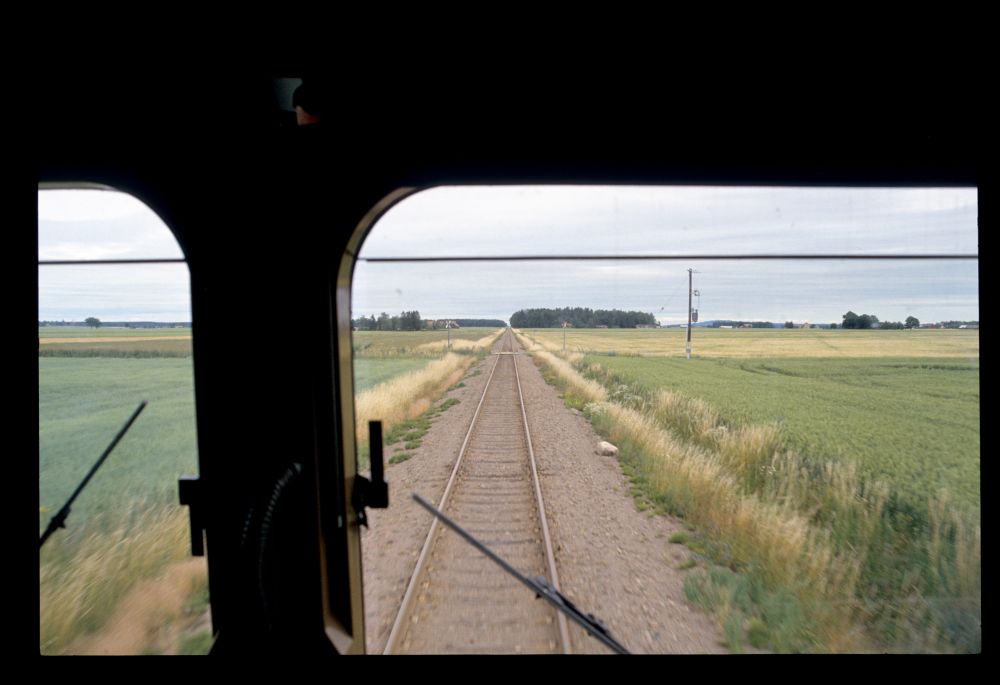
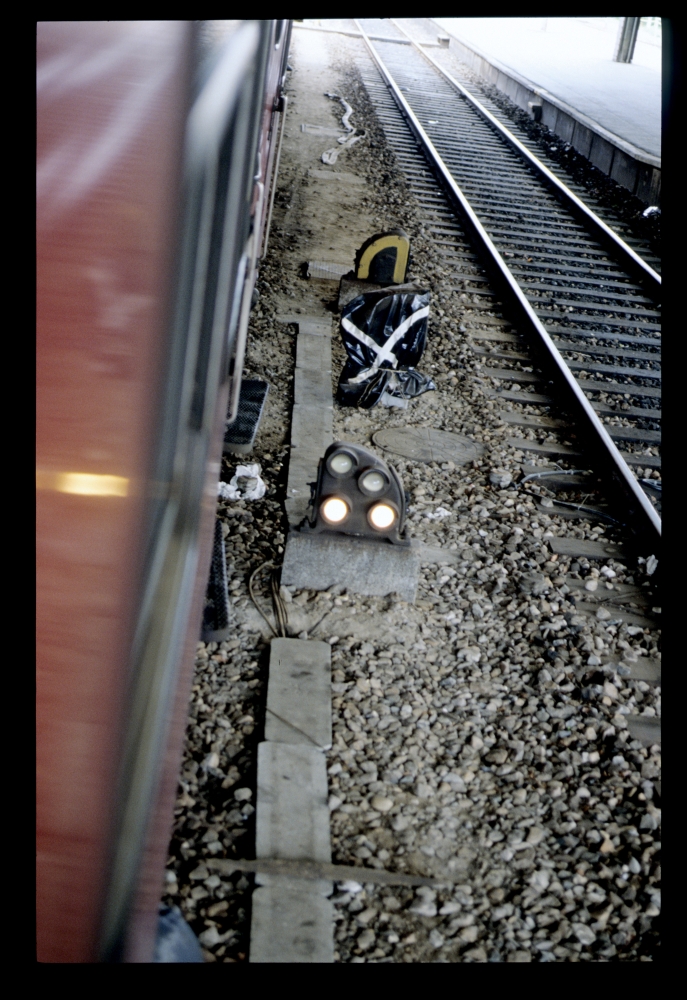
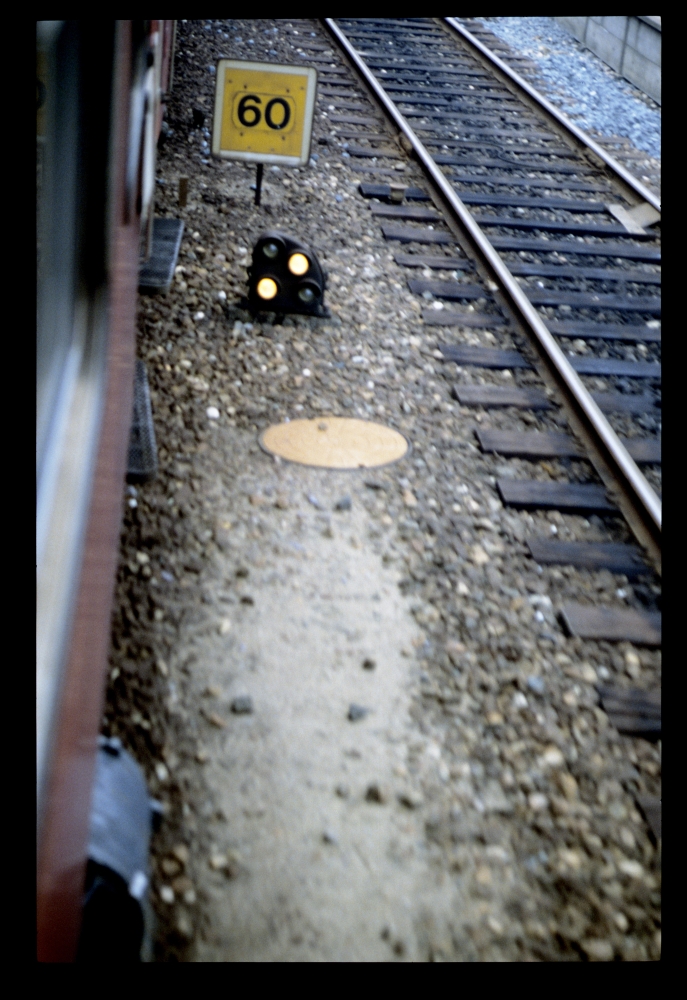
Here are a few shots out of the rail car from the journey to Lidköping. The first two show a few maintenance cars of Sweden's "banverk" ("banverket" means the rail works; it has since been integrated into trafikverket, i.e. the traffic works, which is Sweden's national agency for all traffic networks and facilities):

Maintenance car of banverk, near Herrljunga, 17.7.1989
Maintenance cars of banverk, near Herrljunga, 17.7.1989
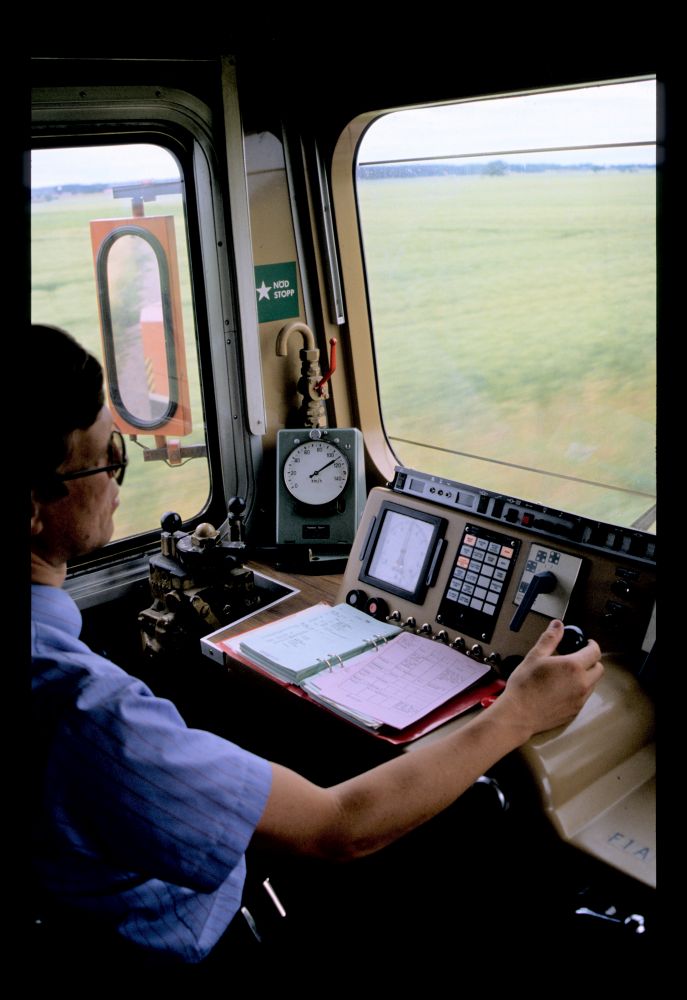
This view into the driver's cab of our Fiat Y1 is almost the same as the fourth one on this page, which explains (in Swedish) the ATC (Automatic Train Control) system. In contrast to that picture, mine does not show any speed indications—the line to Mariestad had not been equipped with ATC in 1989:

Driver's seat on Y1 1271, near Herrljunga, 17.7.1989
The ballast used for the line seems to be a quite fine-grained gravel:

Tracks, near Herrljunga, 17.7.1989
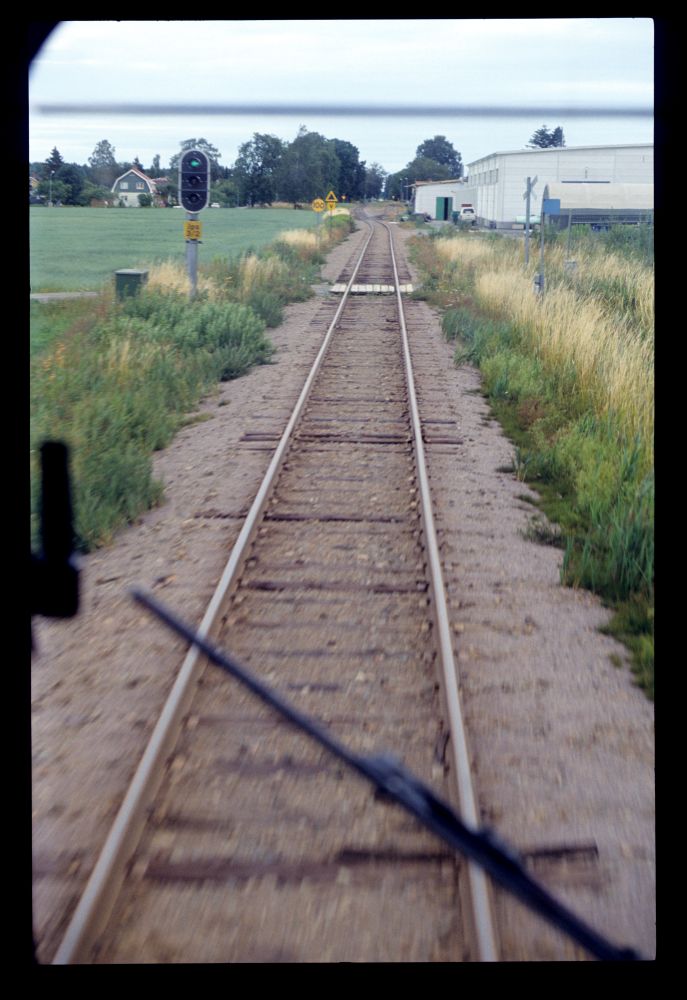
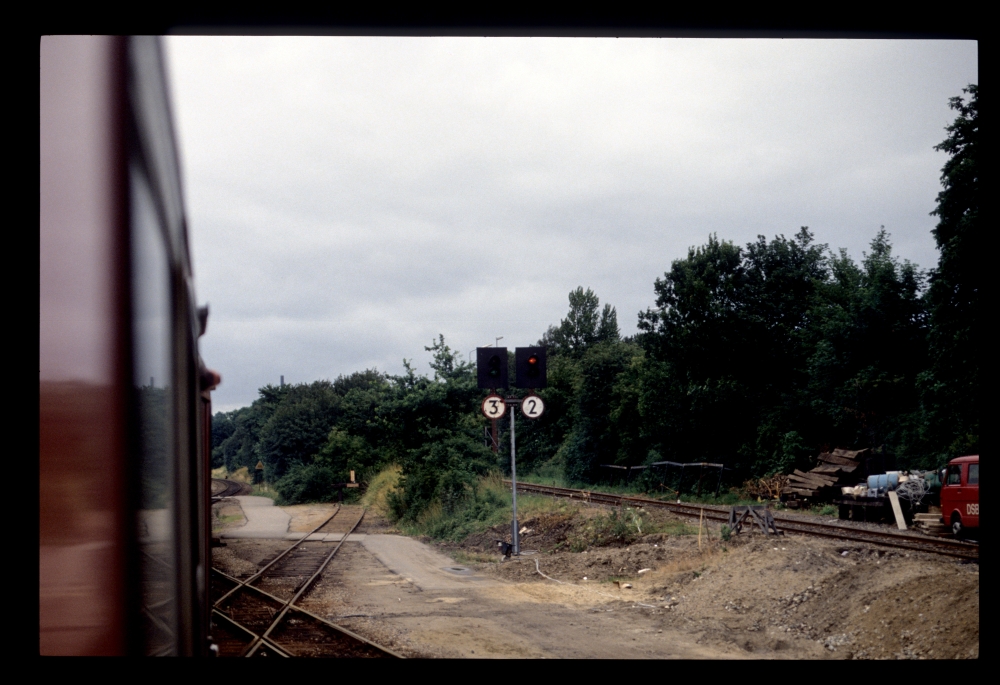
Here is a picture of the home signal Jps 3/2 of Järpås:

Line near Järpås, 17.7.1989
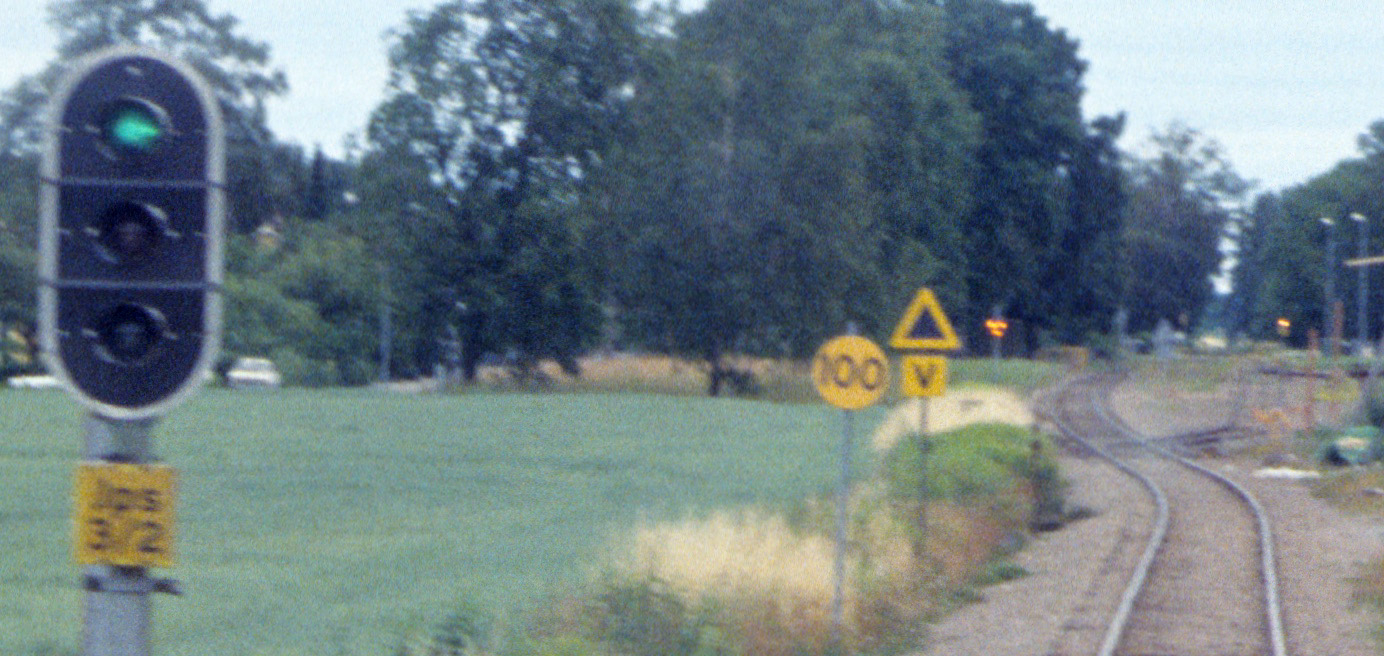
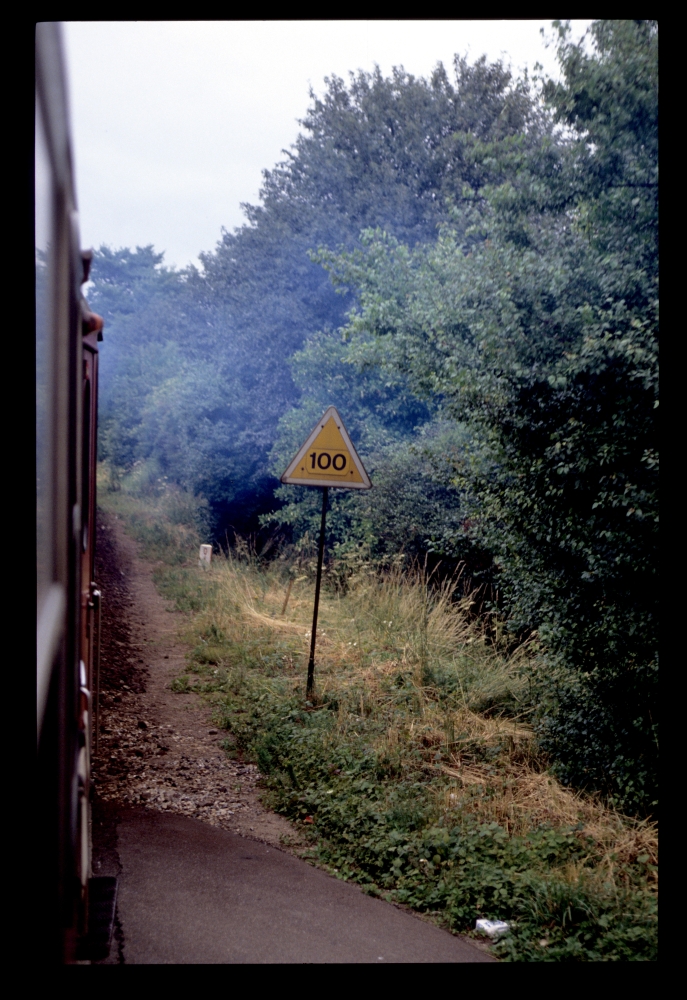
The following enlargement from the previous image shows a few more signals. Left to right, one can see:
  • The cleared home signal;
  • a speed sign for 100 km/h;
  • then an indicator for the following level-crossing distant signal (V = "väg" = "way");
  • and finally, the (blurred) three lights of that level-crossing distant signal.
(A click on the image shows it in full film resolution):

Signals near Järpås, 17.7.1989
Thursday, October 19, 2017

A journey to Sweden, 1989: Alingsås

Deutsche Version dieses Postings

From Denmark to Sweden, we used the ferry to Gothenburg (Göteborg), and from there we took a suburban train to Alingsås, which had a very nice youth hostel in an old villa.

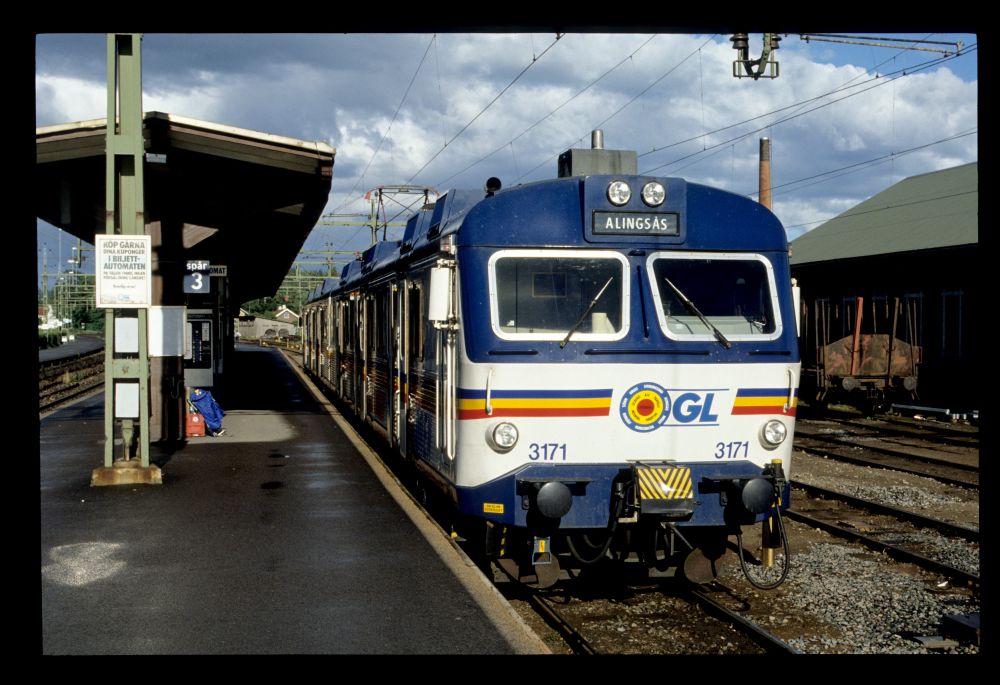
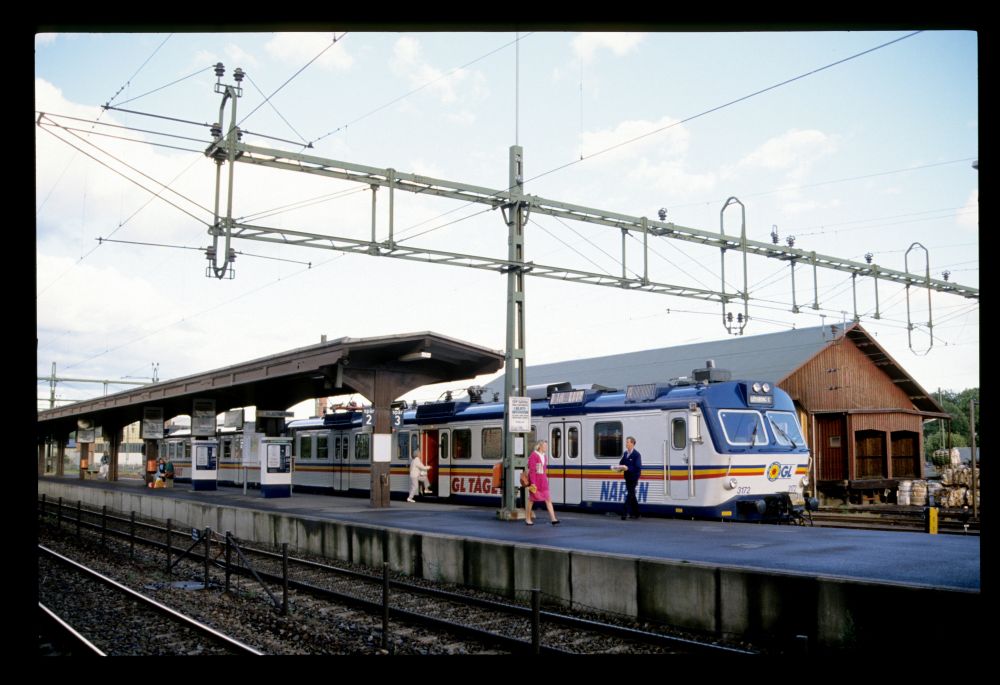
The first picture shows the class X10 railcar which brought us from Gothenburg to Alingsås. A short time before, a shower had come down, but now, the sun came out between the clouds:

SJ X10 3171, Alingsås, 16.7.1989
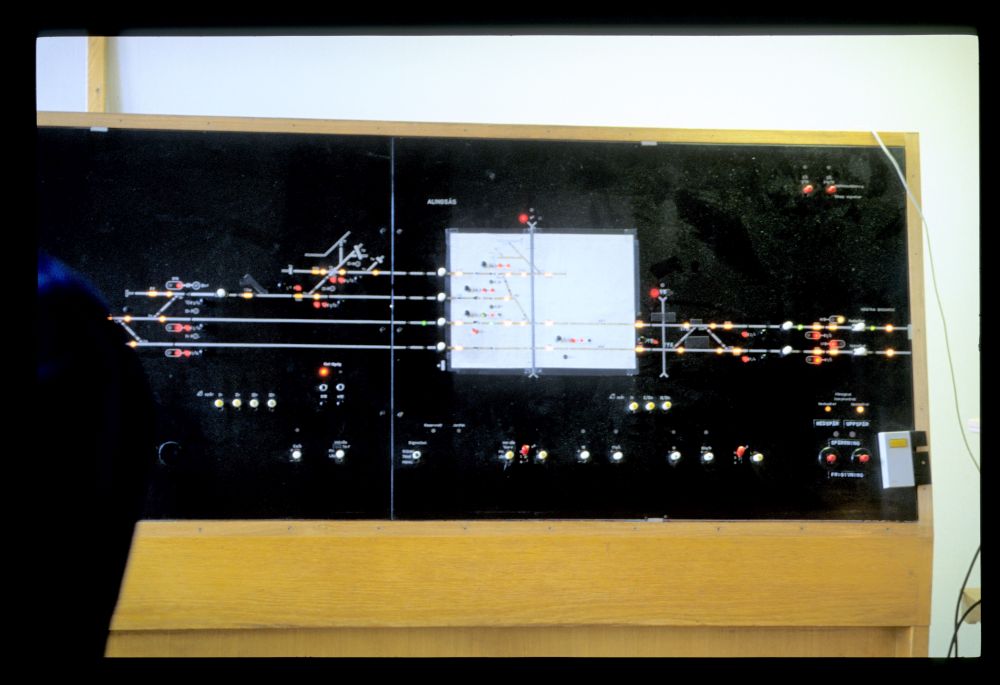
I have a single picture of the interlocking panel, which is unfortunately quite blurred. It is hard to see anything useful, but one can see that the signals are located on the left side of the tracks, in contrast to Germany and Austria and also Denmark:

Interlocking panel, traffic bureau, Alingsås, 16.7.1989
Some people wait for a fast train to Gothenburg, while the interurban sits at its platform:

SJ X10 3171, Alingsås, 16.7.1989
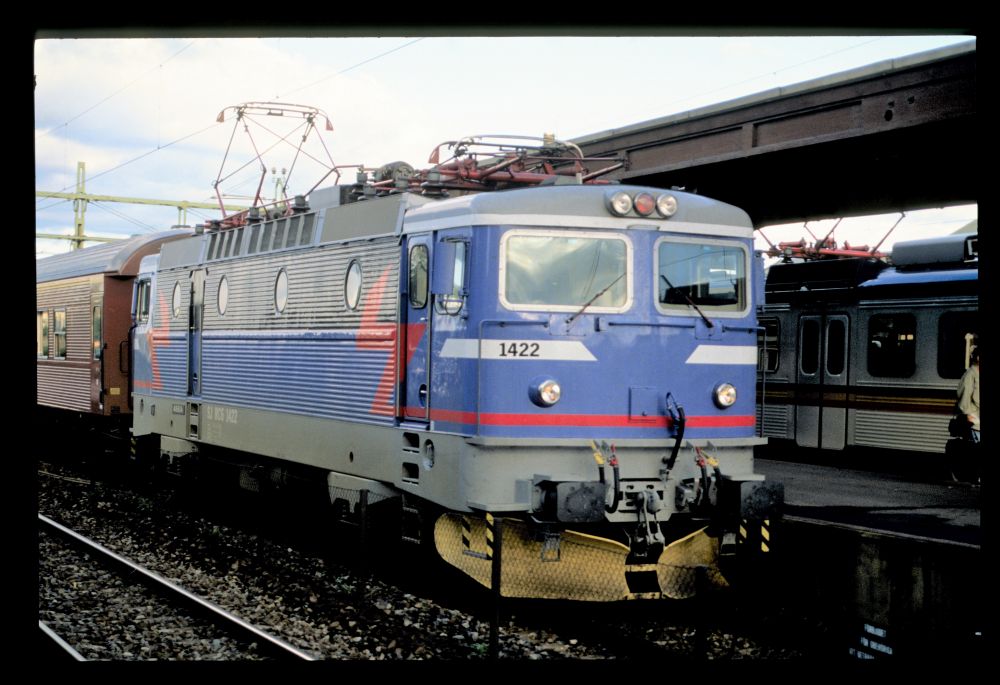
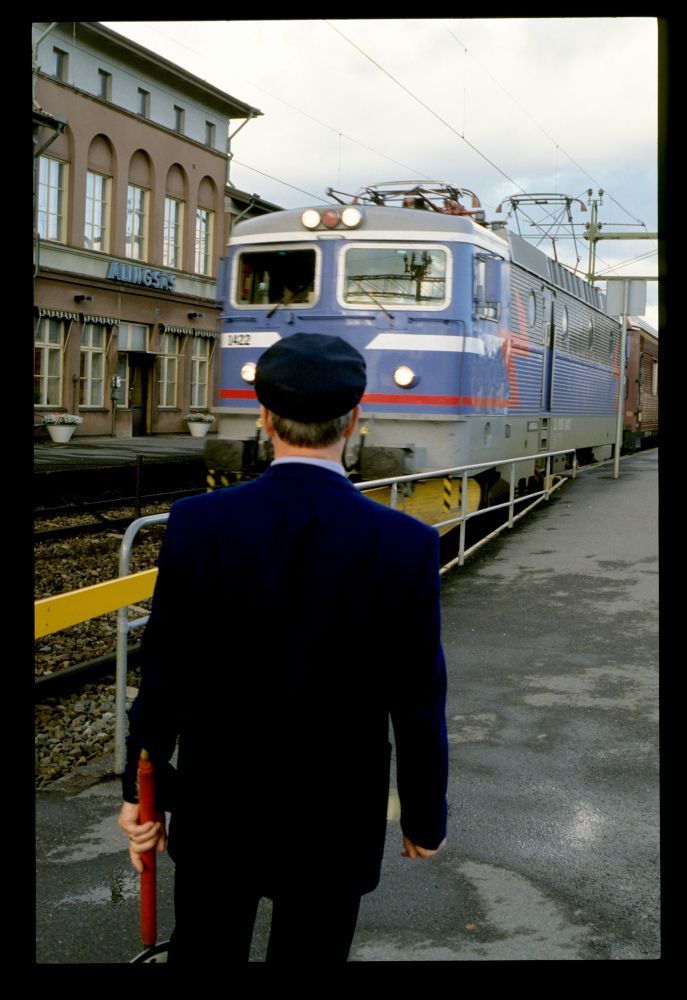
Here is the fast train:

SJ Rc6 1422, Alingsås, 16.7.1989

SJ Rc6 1422 and X10 3171, Alingsås, 16.7.1989

The crossing over the tracks is protected by barriers. The Rc6 is starting to pull its train out of the station:

SJ Rc6 1422, Alingsås, 16.7.1989

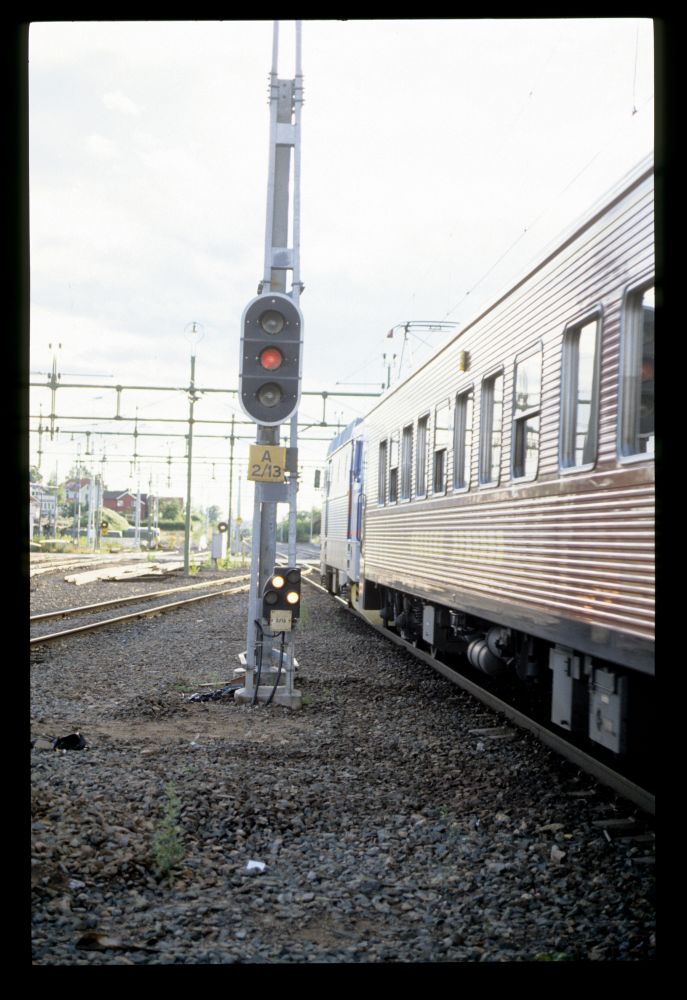
Here is starting signal A 2/13—already returned to stop—and shunting signal 2/13:

Starting signal A 2/13 and shunting signal 2/13, Alingsås, 16.7.1989

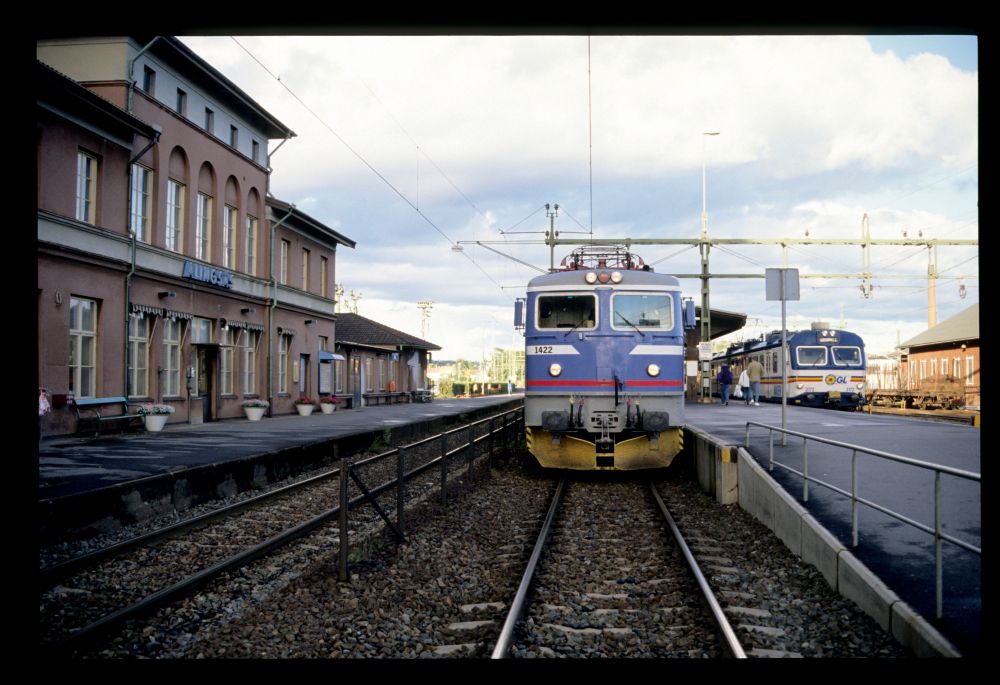
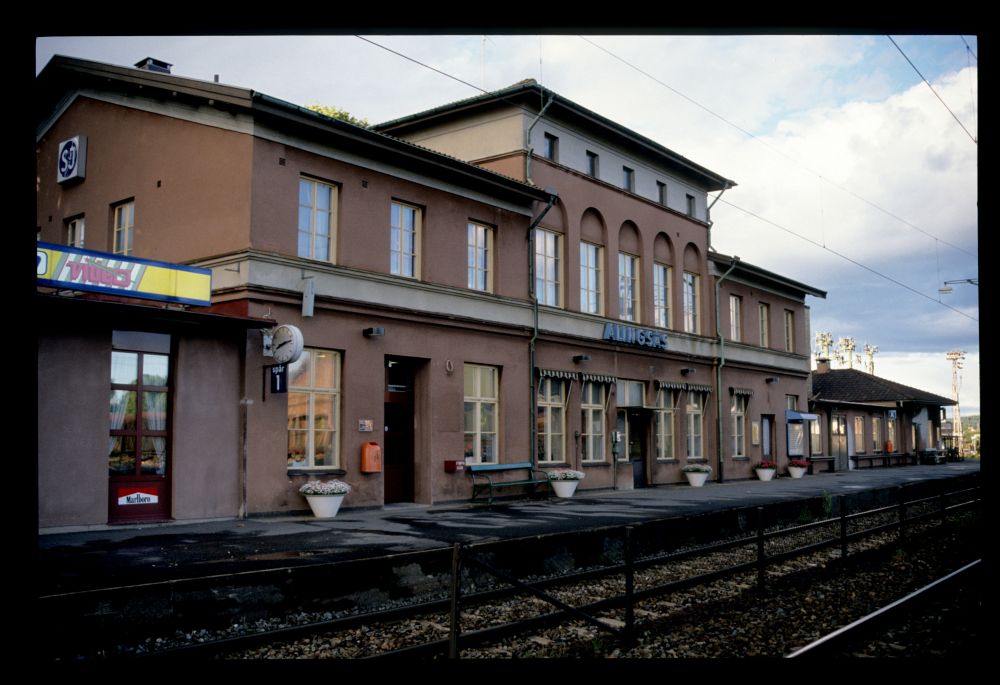
And finally, here's a picture of the station building:

Station building, Alingsås, 16.7.1989


Tuesday, October 10, 2017

A journey to Sweden, 1989: Signals and trains in Denmark

Deutsche Version dieses Postings

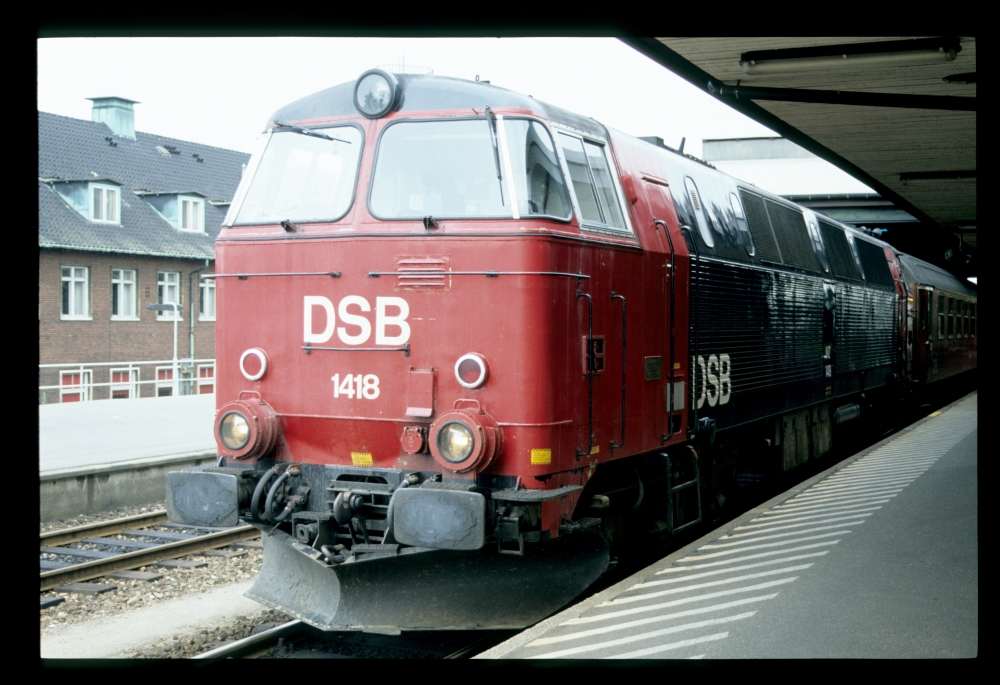
Here are a few photos taken from the train while travelling through Denmark. Of most, I do not know where I made them:

DSB MZ 1418, Denmark, 15.7.1989

Two dwarf signals—one has already fallen back, the second one is still cleared:

Dwarf signal, Denmark, 15.7.1989

Dwarf signal, Denmark, 15.7.1989

Two starting signals ("udkørselssignal")—the left one is cleared, the other one displays stop. The numbers below the signals indicate the assignment to tracks:

Denmark, 15.7.1989

"Accelerate to 100 km/h"—in the signal book, this is under the heading "standsignaler for hastighedsnedsættelse", which means "signs for speed reduction". But it is explained as "kør hurtigere" = "drive faster":

Speed sign, Denmark, 15.7.1989

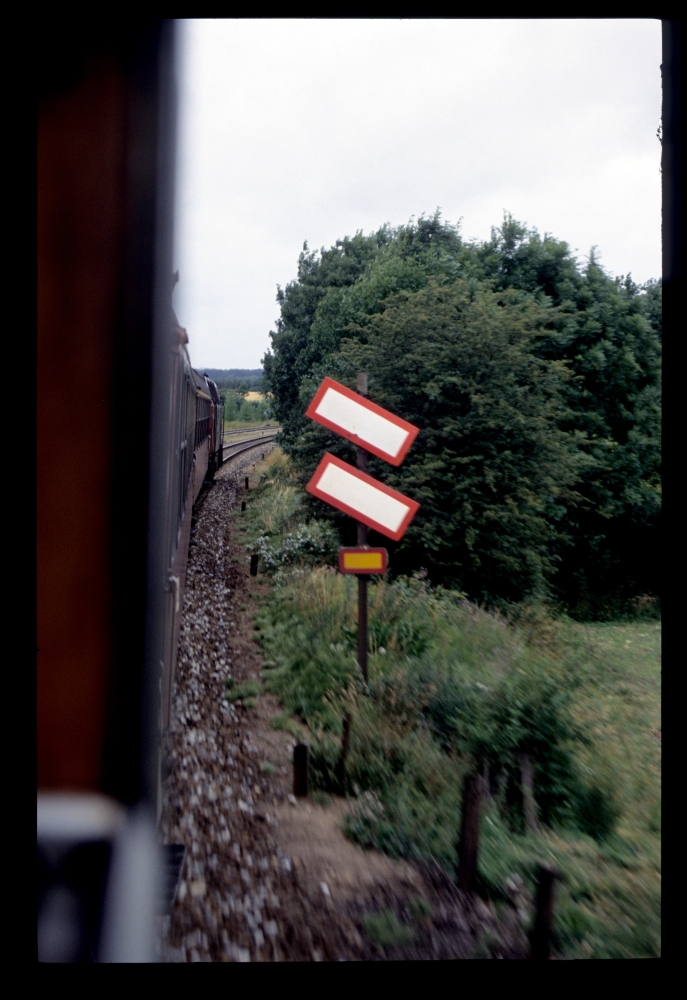
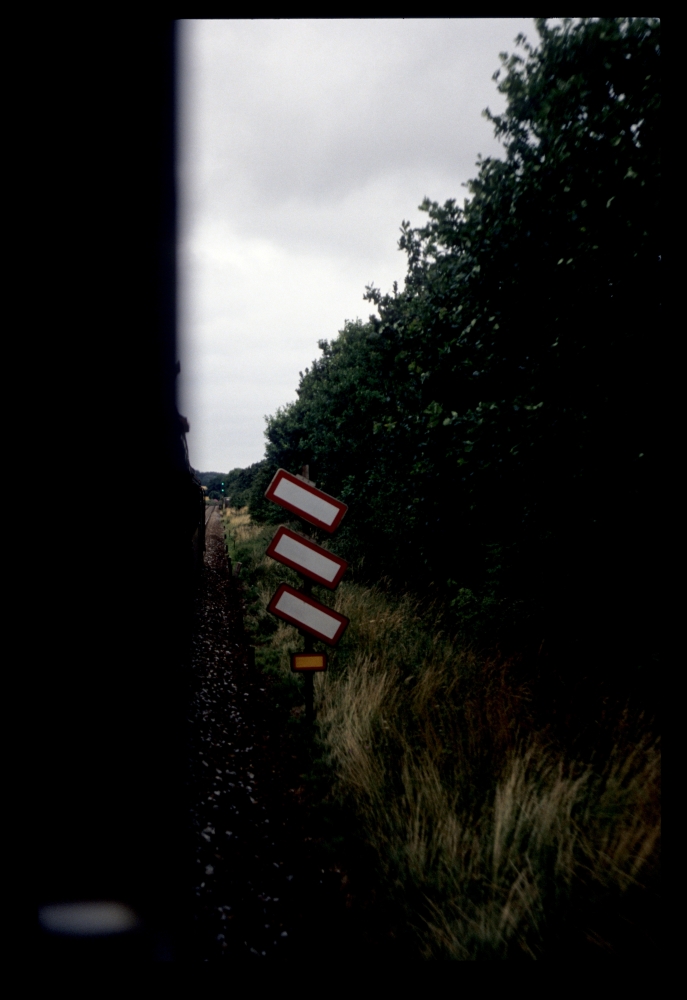
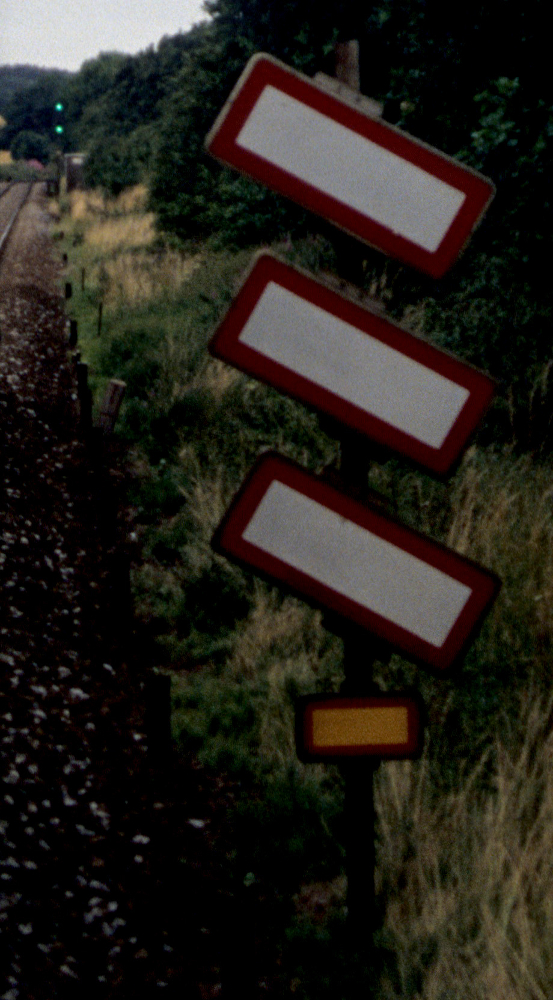
Markers before a home signal—in contrast to the markers for distant signals in Germany and Austria, these ones count upwards: One diagonal rectangle means "1200 m to the home signal", two "800 m to the home signal", and three "400 m to the home signal":

Denmark, 15.7.1989

Far away, one can discern the home signal:

Denmark, 15.7.1989

... enlarged:

Denmark, 15.7.1989

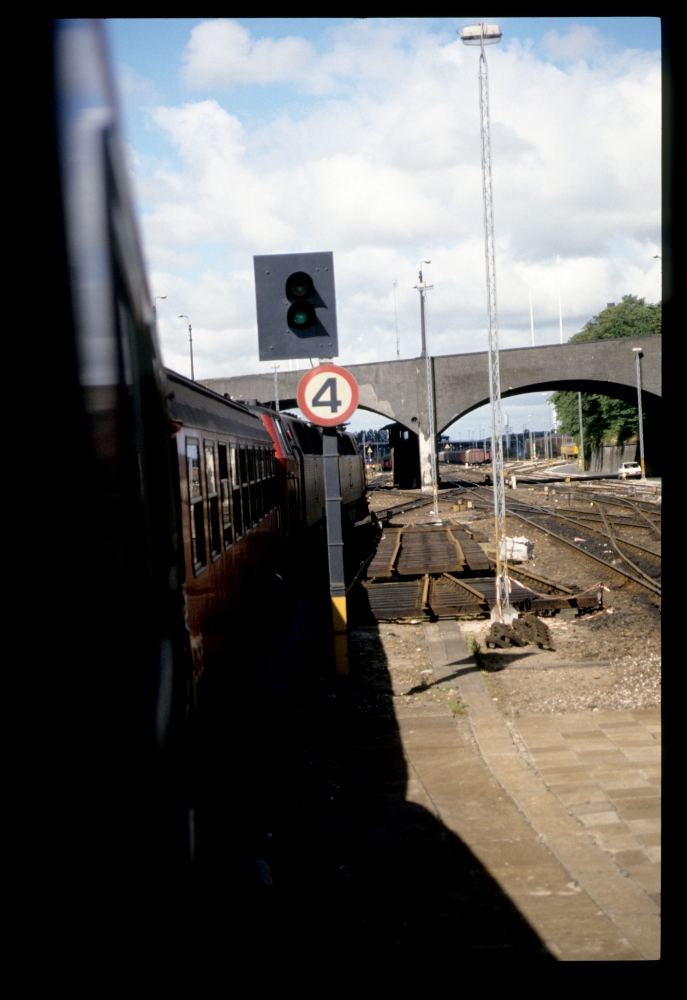
The following photos are from Aarhus. The first one shows the bridge crossing the station tracks on the western side and the starting signal for track 4:

Starting signal, Aarhus, 15.7.1989

An elegant railcar, built in 1983, sits on a storage track (one can find detailed information about Danish rolling stock at www.jernbanen.dk):

DSB HHJ YM 35, Aarhus, 15.7.1989

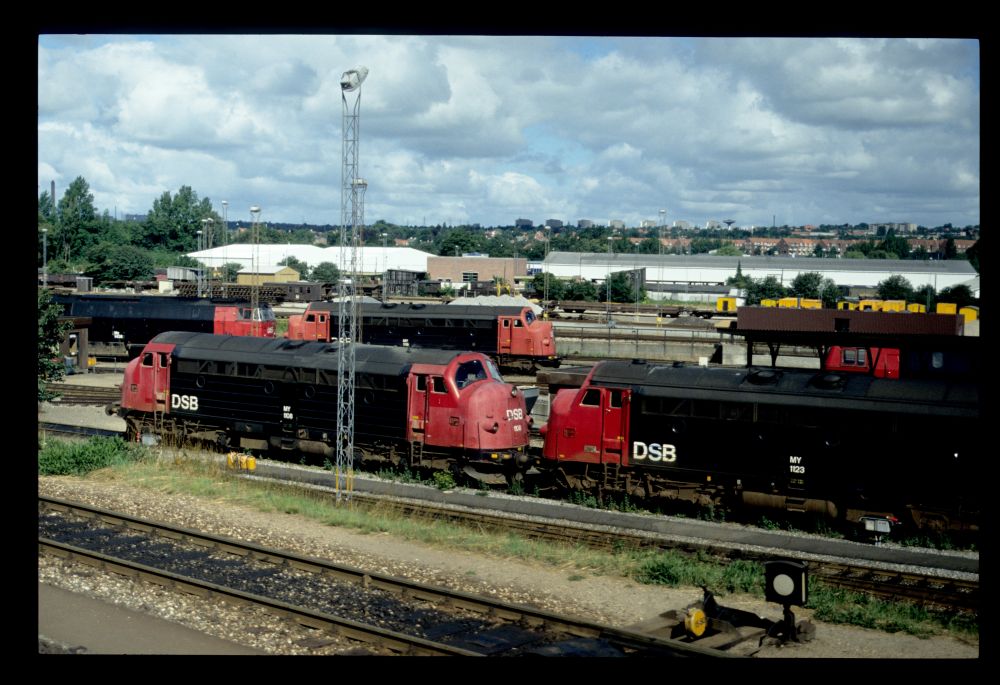
MY 1119, 1108 and 1123 and MZ 1428 lying over:

Depot, Aarhus, 15.7.1989

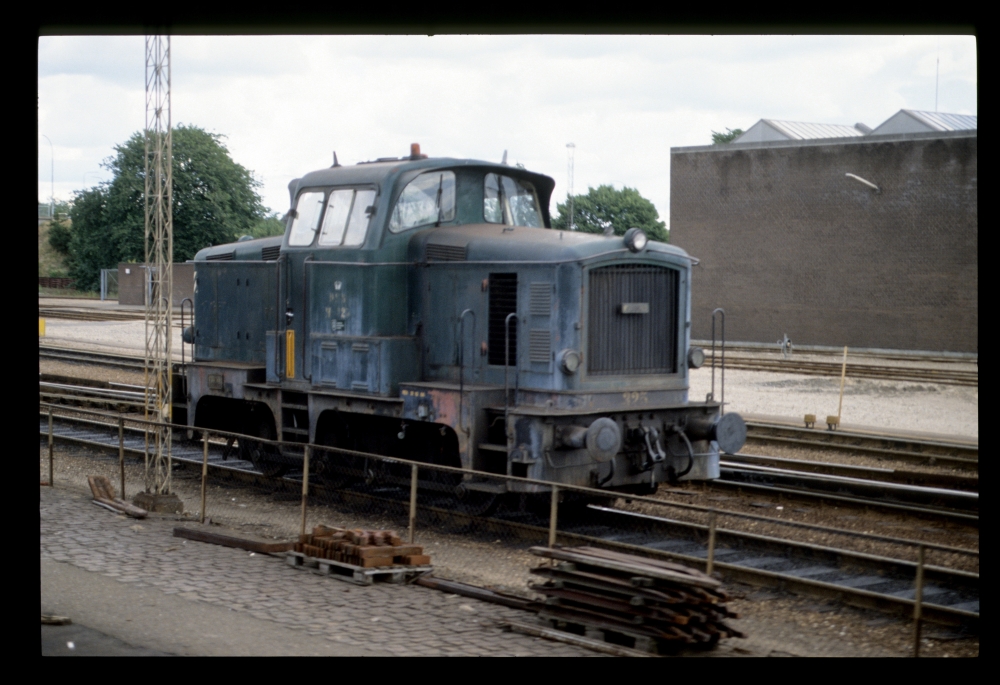
And a final shot of shunting locomotive MH(II) 325:

DSB MH(II) 325, Denmark, 15.7.1989

Monday, October 9, 2017

A journey to Sweden, 1989: Padborg, Denmark

Deutsche Version dieses Postings

In contrast to Switzerland and Great Britain, my knowledge about interlockings in Scandinavia is almost zero—therefore, I will not be able to explain too much about the frames and signals in this and upcoming postings. However, I will try to add links to websites that contain more information.

Back to our journey: A short trip brought us from Flensburg to Padborg in Denmark, where I headed straight for the traffic bureau. Here is the interlocking panel I was allowed to photograph:

Interlocking panel, Padborg, 15.7.1989

One can see that Padborg's station building is situated between the tracks from the following enlargement: The line and dot roughly in the center show the location of the interlocking in the traffic bureau in the station building:

Interlocking panel, Padborg, 15.7.1989

In contrast to Germany and Austria, I have not seen any interlocking panels on our trip that were built from small "domino" pieces. I do not know why the Scandinavian railways (or their interlocking providers) used panels that would have to be replaced completely when the station layout changed. The following picture shows the rightmost part of the panel with an incoming route from Tinglev, the next station to the north:

Interlocking panel, Padborg, 15.7.1989

The following picture got blurred because I did use the flash—however, one can see the various illuminations better here. The lowermost track is marked with green lights, which certainly show that it is part of a locked route. Some tracks farther back show red lamps, which should mean that they are occupied:

Interlocking panel, Padborg, 15.7.1989

And here is another picture of the northern station throat with the incoming route. One can see that the two sets of points connecting two parallel tracks share the same number, suffixed with a and b (01a and 01b, in this case). This is more in line with British custom—in Germany, a and b are used for the blade groups of double slip switches, and in Austria, points are designated by numbers only. Moreover, one can see that also shunting signals are cleared along a train route—this is typical of most railways, but not so in Austria:

Interlocking panel, Padborg, 15.7.1989

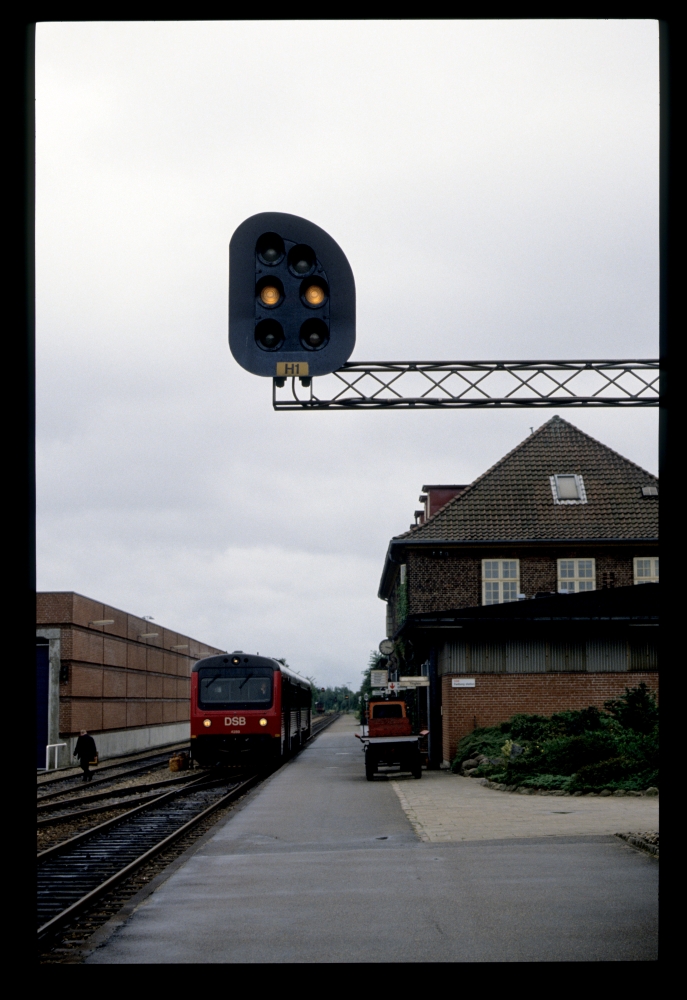
Here is a "perronudkørselssignal" (according to lundsten.dk), which can be translated as "platform starting signal":

Signal H1, DSB MR 4089, Padborg, 15.7.1989

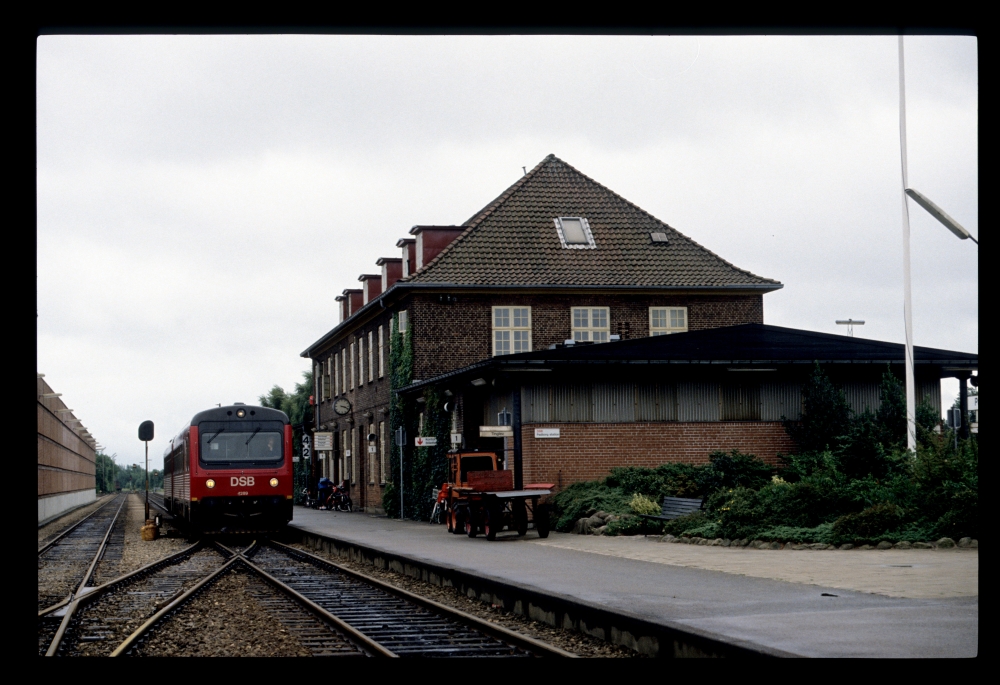
Our train to Tinglev is waiting here in front of the station building:

Station building, Padborg, 15.7.1989

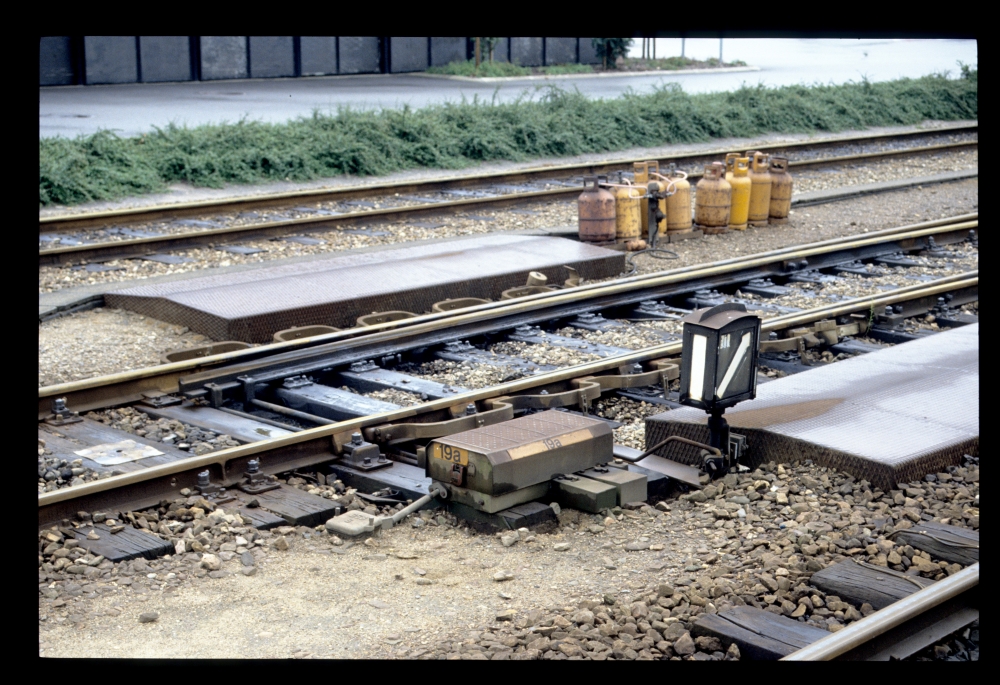
The housing of points machine no. 19a looks like the widely used Siemens type S700, but the blades are connected directly to the points rodding, so that this machine uses internal blade locks, in contrast to the typical external claw locks used in Germany and Austria. This can also be deducted from the fact that the motor is securely mounted on lengthened sleepers (whereas Austrian and German points machines are mounted on smaller—some might say flimsy—brackets). The gas cylinders of the points heating are simply put on flat sheet metal pieces (in contrast to Austria, where such cylinders were put into their own cages):

Points 19a, Padborg, 15.7.1989

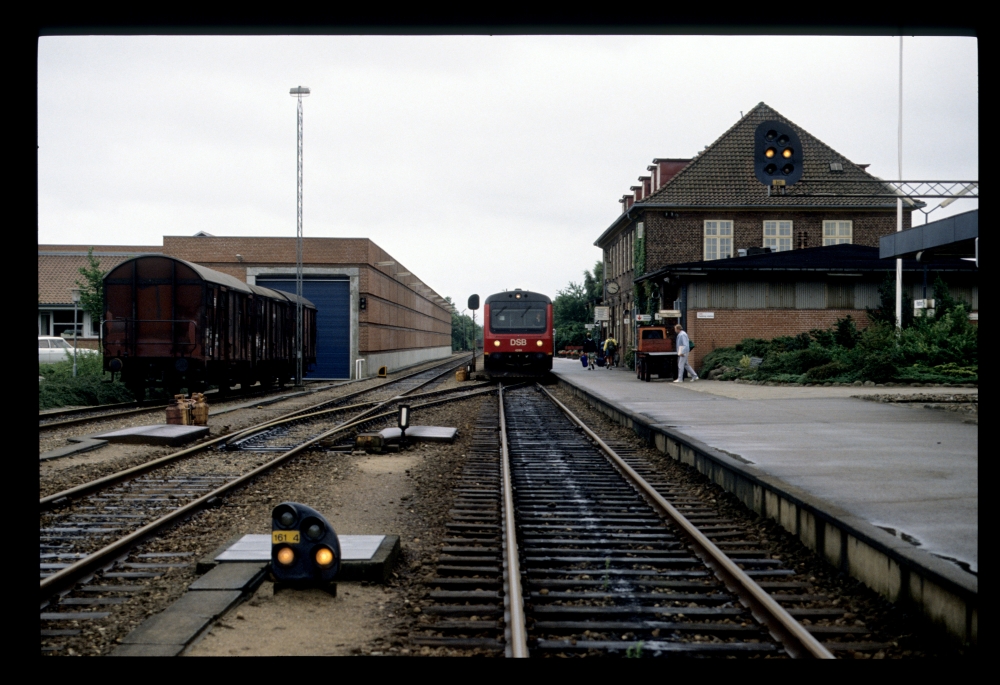
Here is dwarf signal ("dværgsignal") 161.4, just in front of points 19a:

Dwarf signal 161.4 and points 19a, DSB MR 4089, Padborg, 15.7.1989

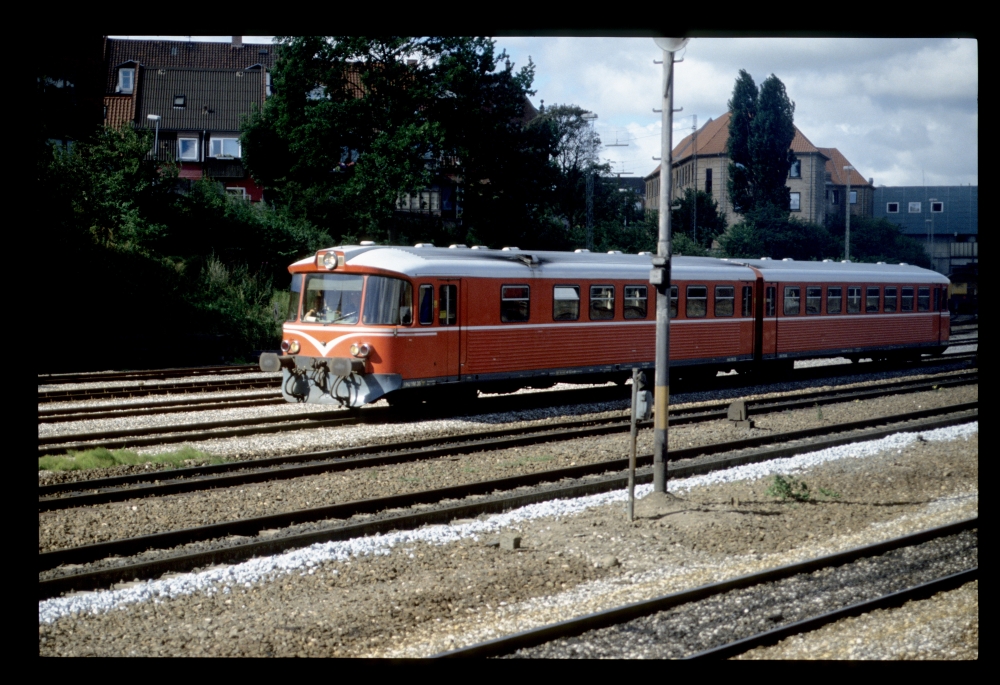
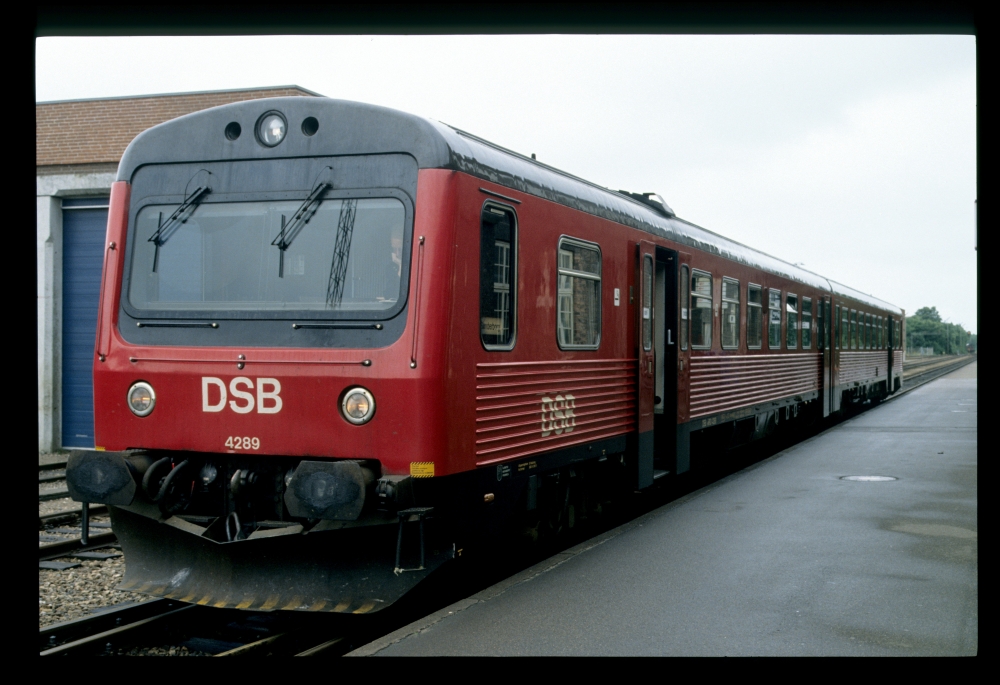
Motor car 4289 of DSB class MR+MRD:

DSB MRD 4289, Padborg, 15.7.1989

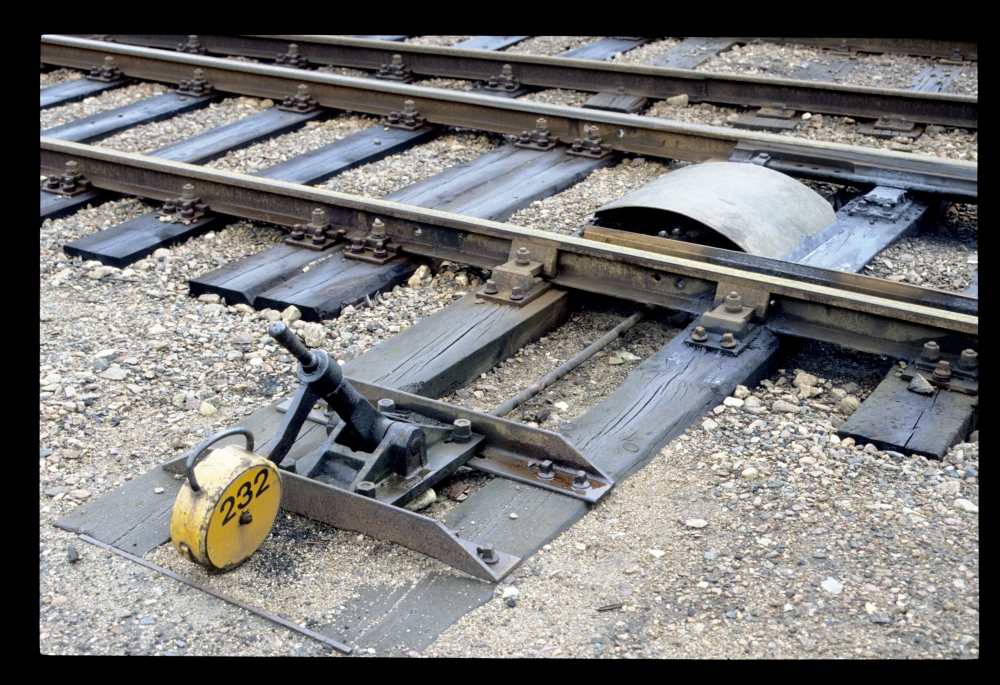
Somewhere near the station building, I took this picture of locally operated points 232, with a swinging weight, as they are used in Austria and Italy:

Points 232, Padborg, 15.7.1989

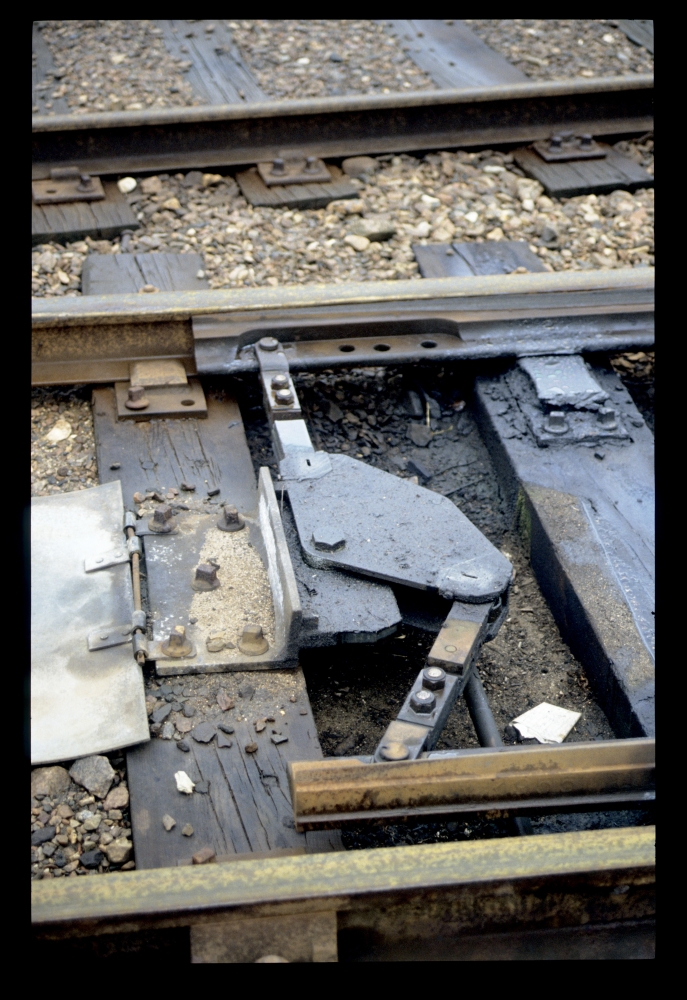
I even opened (without having asked, I assume) the cover of the blade locking mechanism—a typical center lock with an elbow lever to press the blade against the stock rail:

Points 232, Padborg, 15.7.1989

And that's it from Padborg.

Sunday, October 8, 2017

A journey to Sweden, 1989: Rendsburg High Bridge and Flensburg

Deutsche Version dieses Postings

The next twenty or so postings will contain about 300 pictures from 1989 from a journey by train to Sweden. There will be a number of "locomotives and stuff" snapshots, but also signals and interlockings.

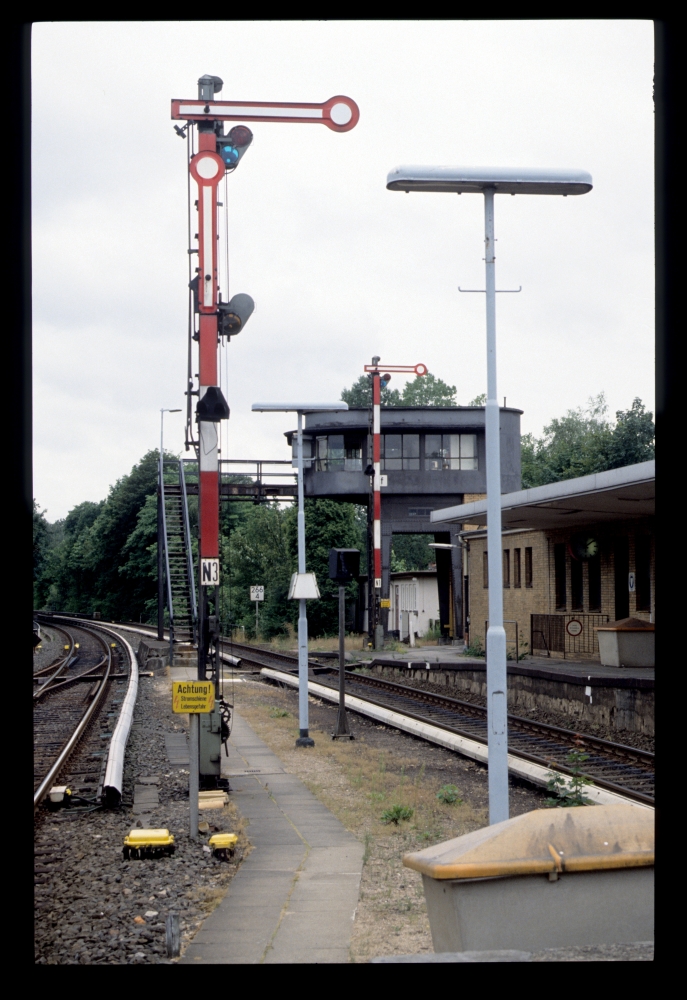
This first posting, however, contains some pictures I shot in northern Germany. At Reinbek near Hamburg, I took a photograph of two semaphores and the well-known signal box in the background:

Starting signals N3 and N1, sigal box Rf, Reinbek, 15.7.1898

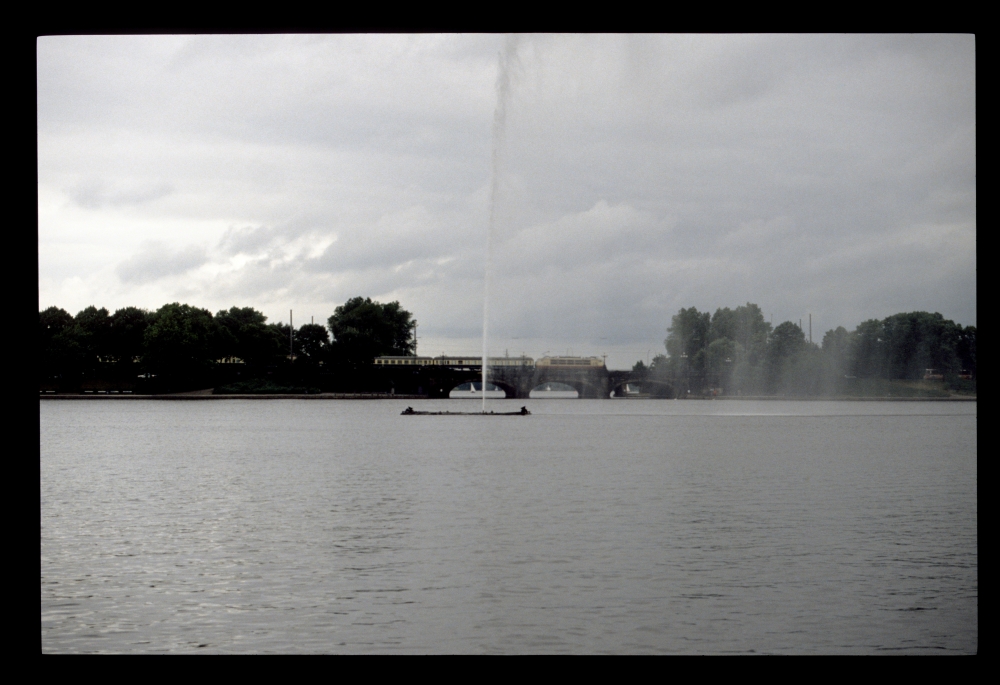
DB's class 103 was still a common sight throughout Germany—here is one behind the Alster in Hamburg:

Alster and class 103, Hamburg, 15.7.1898

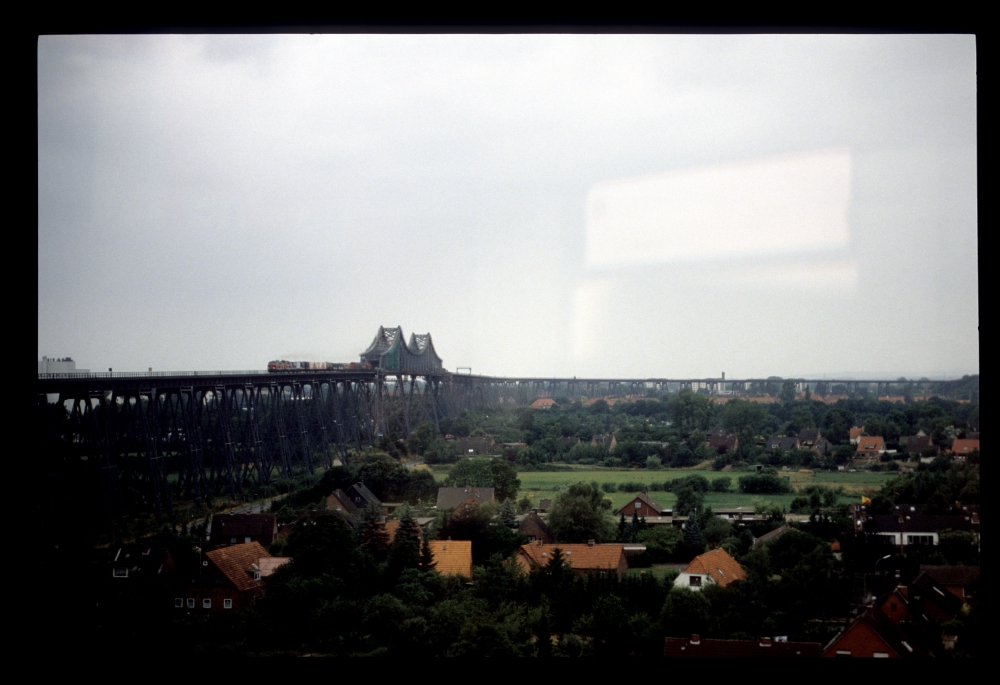
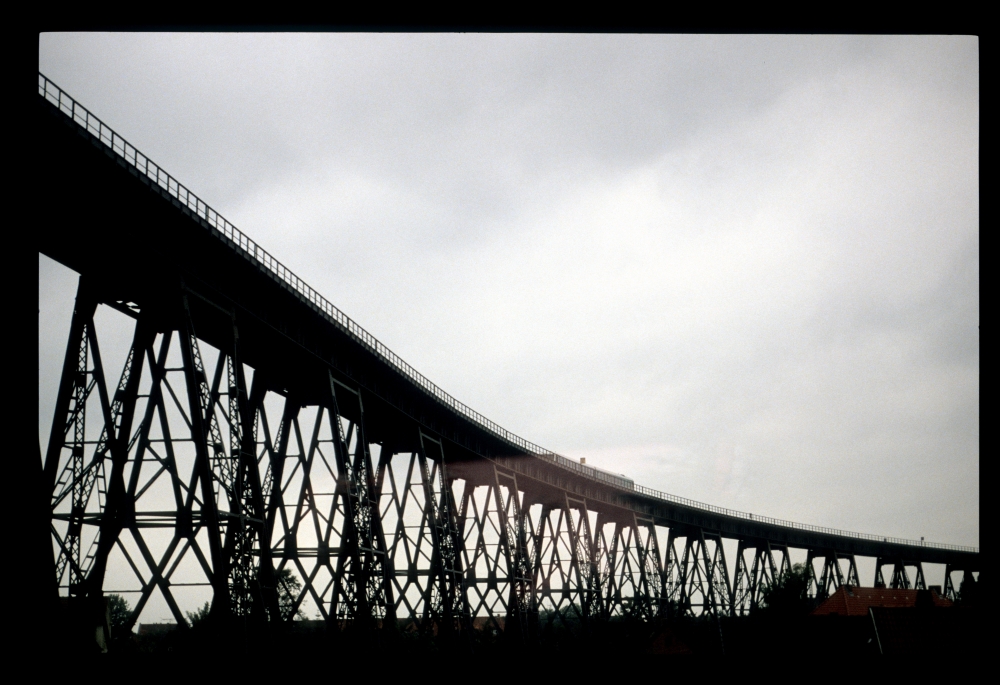
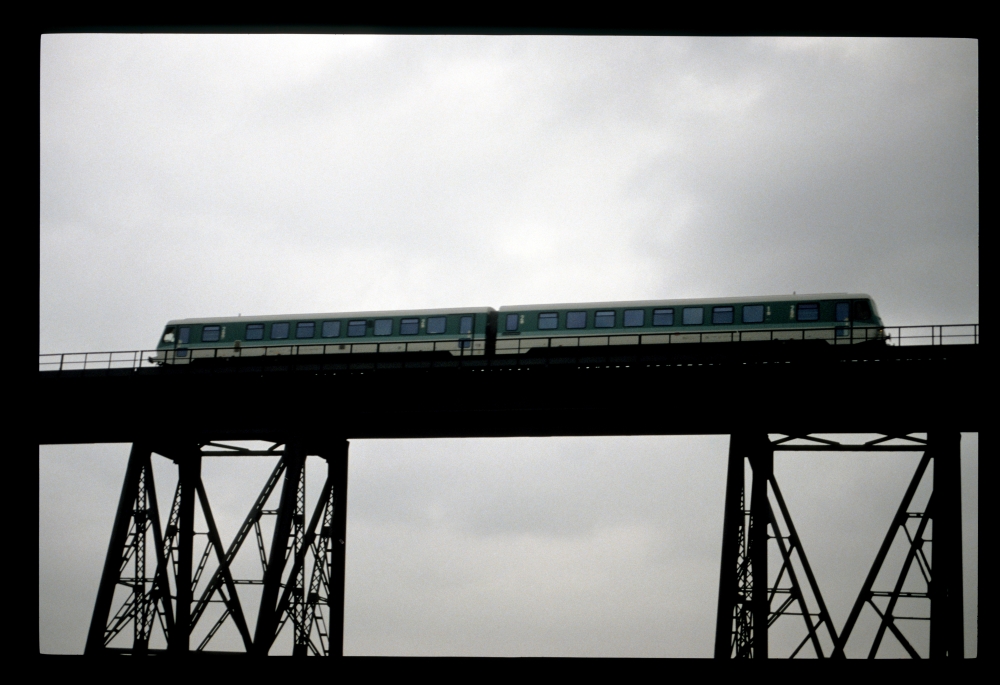
All the following pictures of the Rendsburg High Bridge were taken from our train:

Rendsburg High Bridge, 15.7.1989

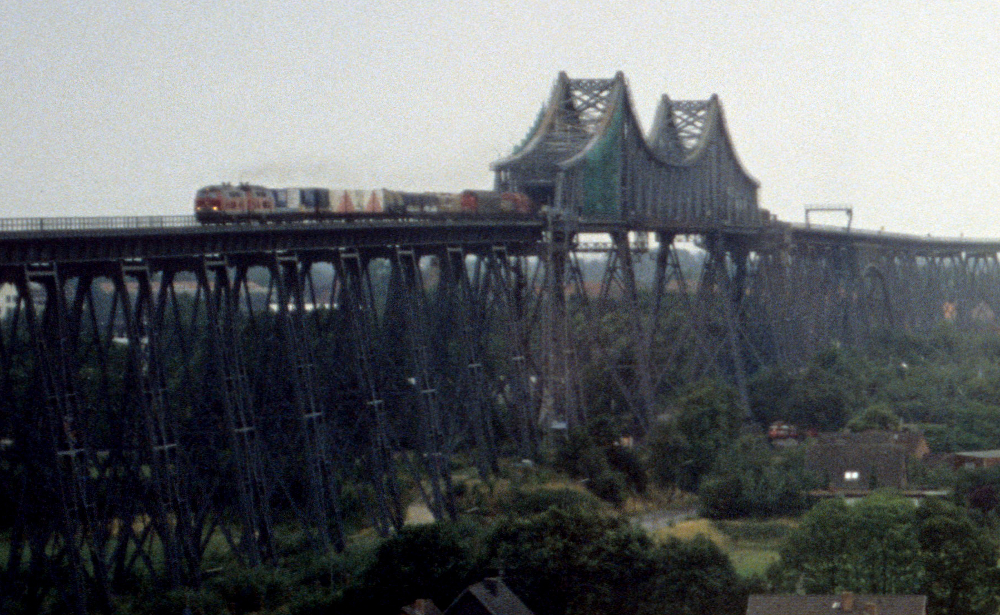
The following enlargement from the previous photograph shows the two class 218 locomotives pulling their train over the center span:

Two class 218 locomotives with a goods train on the Rendsburg High Bridge, 15.7.1989

Rendsburg High Bridge, 15.7.1989

Rendsburg High Bridge, 15.7.1989

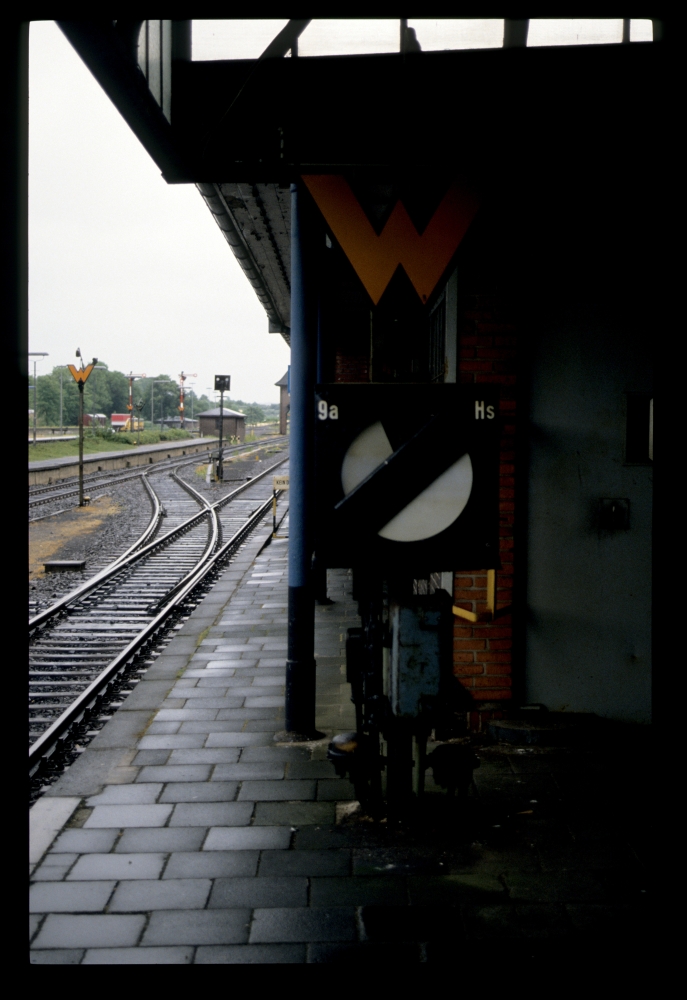
At Flensburg, I took two images of a shunting signal:

Shunting signal 9a, Flensburg, 15.7.1989

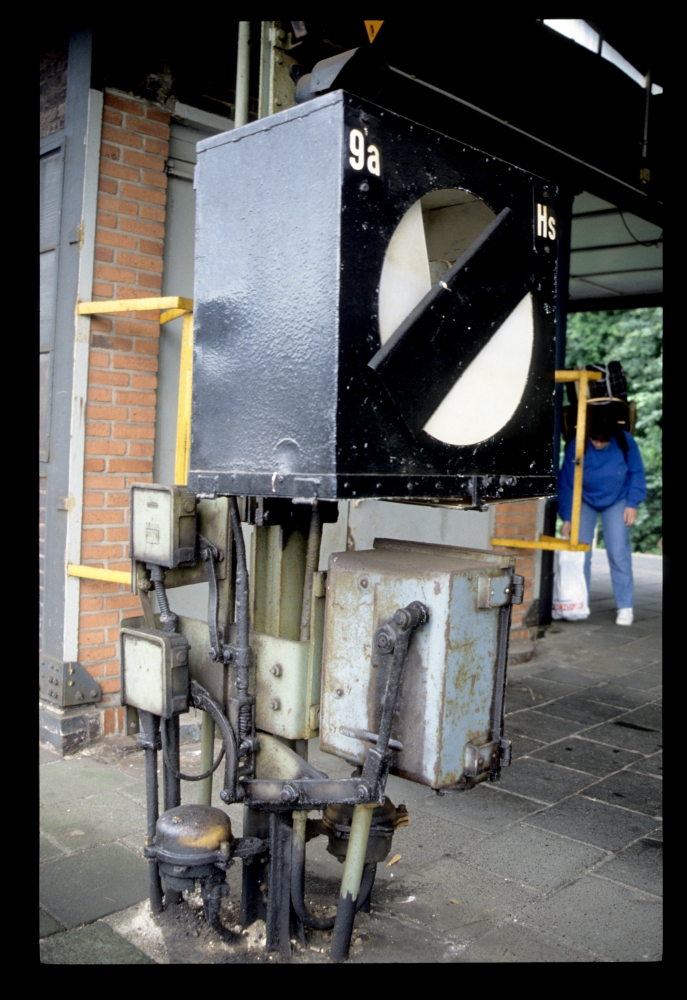
It is amazing how much metal and levers are necessary to convey a single bit of information:

Shunting signal 9a, Flensburg, 15.7.1989

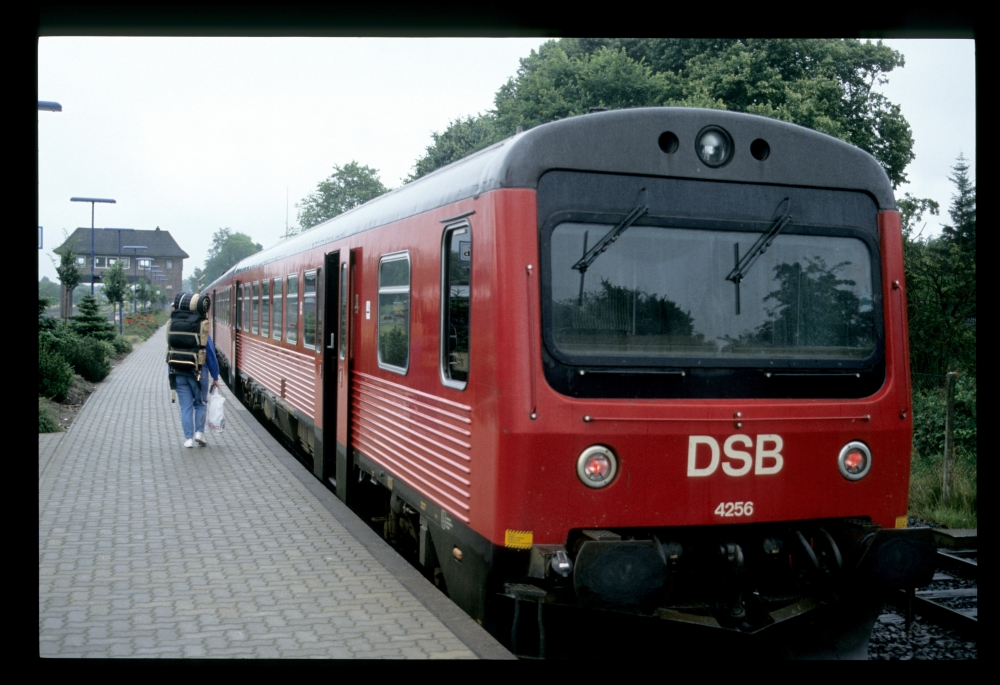
And here is our connecting train to Padborg on the Danish side of the border. In the background, just to the right of the signal box, one can discern the two arms of the cleared semaphore:

DSB MR 4256, Flensburg, 15.7.1989

The next posting will then show a few pictures from Padborg.